Probing Kinematic Chain Reasoning in Video Diffusion Transformers: A Study of 2D Gear System
Video diffusion transformers (DiTs) are increasingly viewed as promising models for learning physical dynamics directly from video. However, off-the-shelf models struggle to generate physically plausible gear motions, even in simple scenarios involving only two gears. Simulating gear mechanisms is conceptually simple yet challenging, as the motion of a single gear strictly dictates the kinematics of the entire system. In particular, determining the rotation direction of each gear requires computing its rotational parity by traversing the underlying kinematic chain.
To investigate whether video DiTs can learn such kinematic chain reasoning, we utilize 2D involute gear trains as a testbed to fine-tune and analyze off-the-shelf video DiTs. Our analysis reveals that, after fine-tuning in this setting, models can indeed learn kinematic chain reasoning, but they acquire two distinct types of reasoning mechanisms depending on the kinematic heights encountered during training: when trained on mechanisms with short kinematic heights, the model acquires a parallel BFS-like reasoning, using transformer layers as breadth-first search steps to incrementally determine parity across the kinematic tree. Conversely, when exposed to large kinematic heights during training, the model adopts a divide-and-conquer-like strategy—first resolving parity within local neighborhoods and subsequently merging them to achieve global consistency. Overall, our work demonstrates an example of video DiTs learning algorithmic reasoning over kinematic chains, while also uncovering their generalization limits and highlighting the critical role of training data complexities.
In this paper, we adopt 2D involute gear trains as a testbed for evaluating the ability of video diffusion transformers to simulate systems of simultaneously interacting physical objects with potentially long-chain kinematic dependencies. Specifically, as visualized below, the model is provided with the initial spatial layout of a gear system as the first frame. A single gear is designated as the driving gear, and its full rotational trajectory is provided as a conditioning video. The objective is to synthesize the resulting motion of all remaining gears while satisfying the underlying kinematic constraints. We fine-tune the Wan2.1 (1.3B) text-to-video model. Below, we visualize a few examples of the input and ground-truth data.
Indeed off-the-shelf video generation models* struggle to synthesize kinematically plausible animations of gear systems, even for the simple case of two meshing gears, where the gears rotate in conflicting directions. This raises the question of whether video diffusion transformers are capable of reasoning about such kinematic chain dependencies and, if so, how they achieve this.
*Videos were generated using lumalabs.ai in a standard first-frame-to-video setting.
Despite the aforementioned failures of commercial video diffusion models, our initial findings suggest that, with appropriate fine-tuning, video diffusion transformers can successfully generate videos of gear systems that satisfy the kinematic constraints, even as the number of gears increases substantially. Below demonstrate the some generated examples.
Here the model is trained and tested up to 10-gear system.
Here the model is trained and tested up to 20-gear system.
Here the model is trained and tested up to 30-gear system.
Here the model is trained and tested up to 40-gear system.
Here the model is trained and tested up to 50-gear system.
Here the model is trained and tested up to 100-gear system.
Fine-tuned video diffusion transformers can generate kinematically plausible gear motion, but doing so requires resolving rotational parity across the entire kinematic chain. We therefore perform feature probing on trained DiTs to investigate what reasoning mechanisms emerge internally.
Crucially, the model learns two distinct types of algorithms depending on the kinematic height (denoted as h)—the maximum graph distance from the driving gear—seen during training:
- Parallel-BFS strategy: When the training data contains only small kinematic heights, the model learns a parallel BFS strategy, in which successive groups of transformer layers propagate information outward from the driving gear, one depth at a time.
- Divide-and-Conquer-like strategy: When the model is exposed to larger kinematic heights, for example, when a parallel BFS strategy cannot be implemented due to the limited number of layers, it instead learns a divide-and-conquer-like strategy, in which local parities are first determined and subsequently merged.
The following two sections demonstrate these two reasoning mechanisms, respectively.
We first study models trained on mechanisms with at most 10 gears and kinematic height. Notably, kinematic height is much smaller than the number of layers (30) in the network.
1.1. PCA Analysis
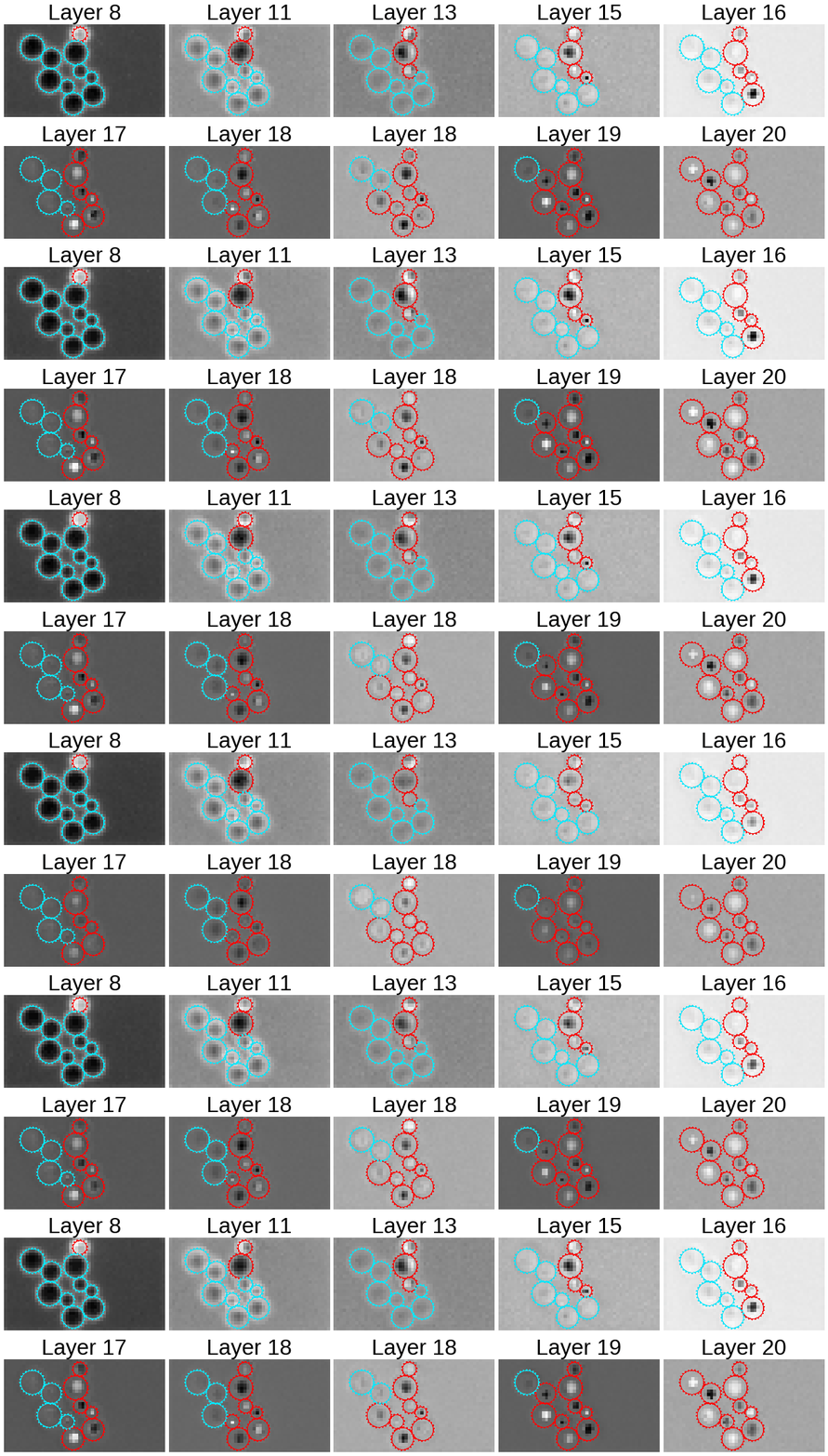
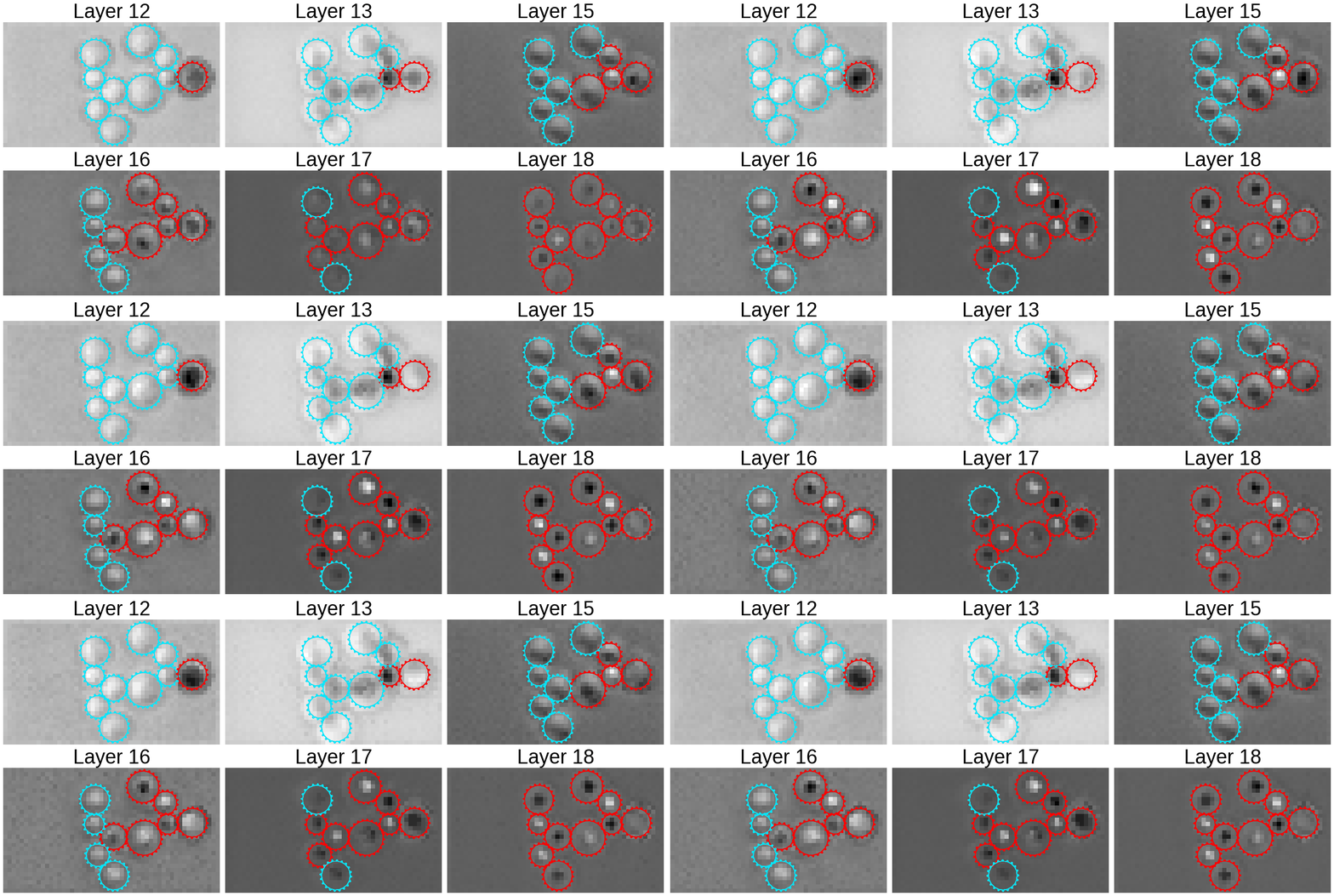
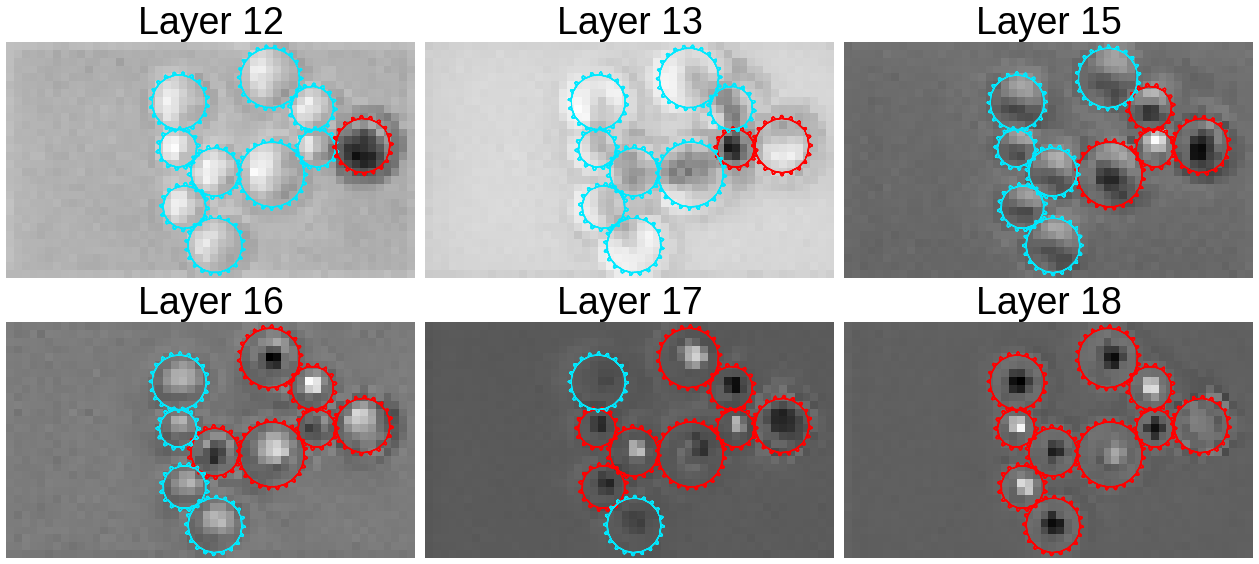
The PCA analysis below reveals an interesting pattern: there is a principal axis that separates features associated with gears of different rotational parity. Remarkably, this parity signal first emerges around the driving gear, and then progressively propagates to neighboring gears across successive transformer layers, resembling a parallel BFS-like progression.
1.2. MLP Probing
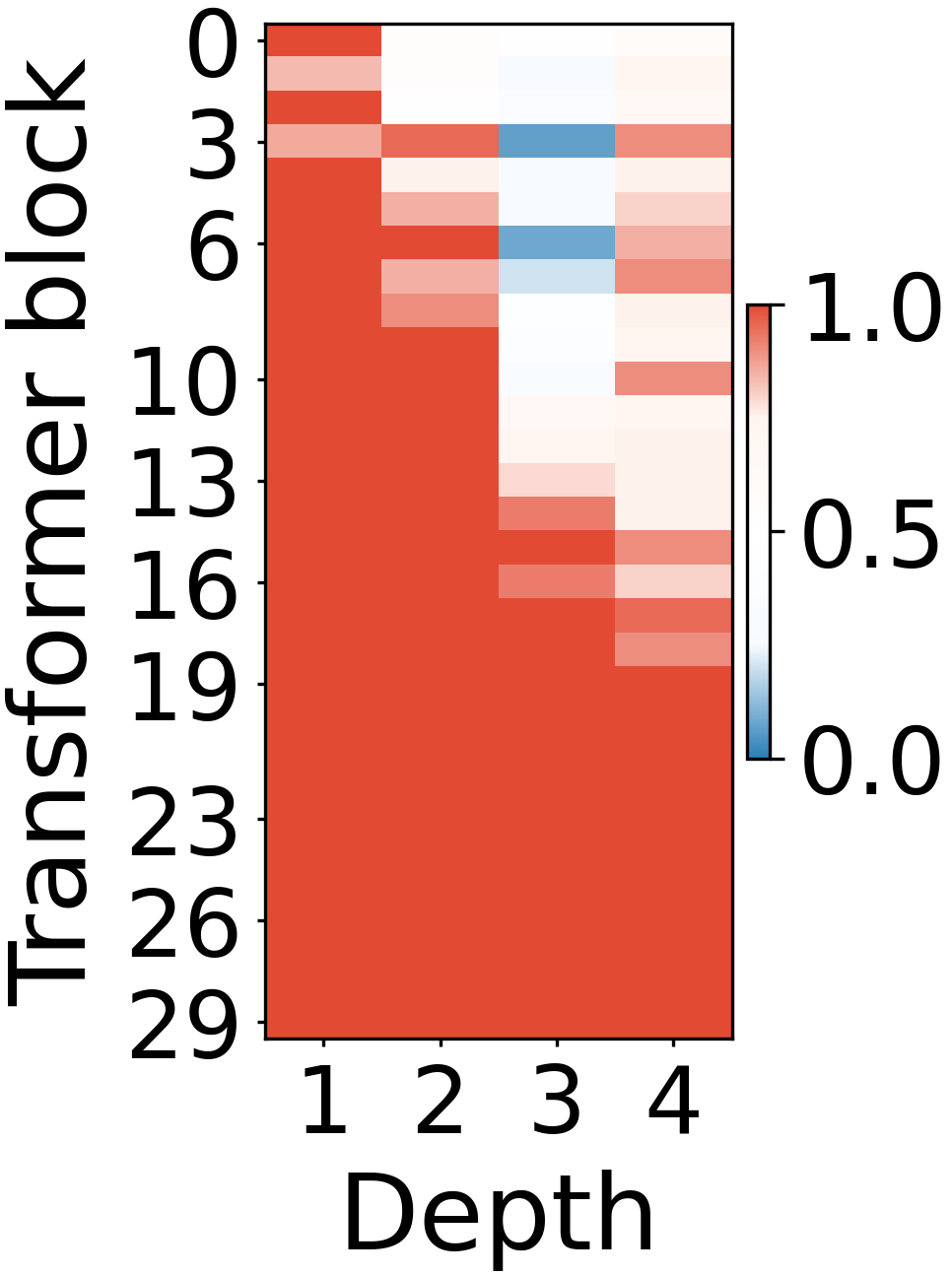
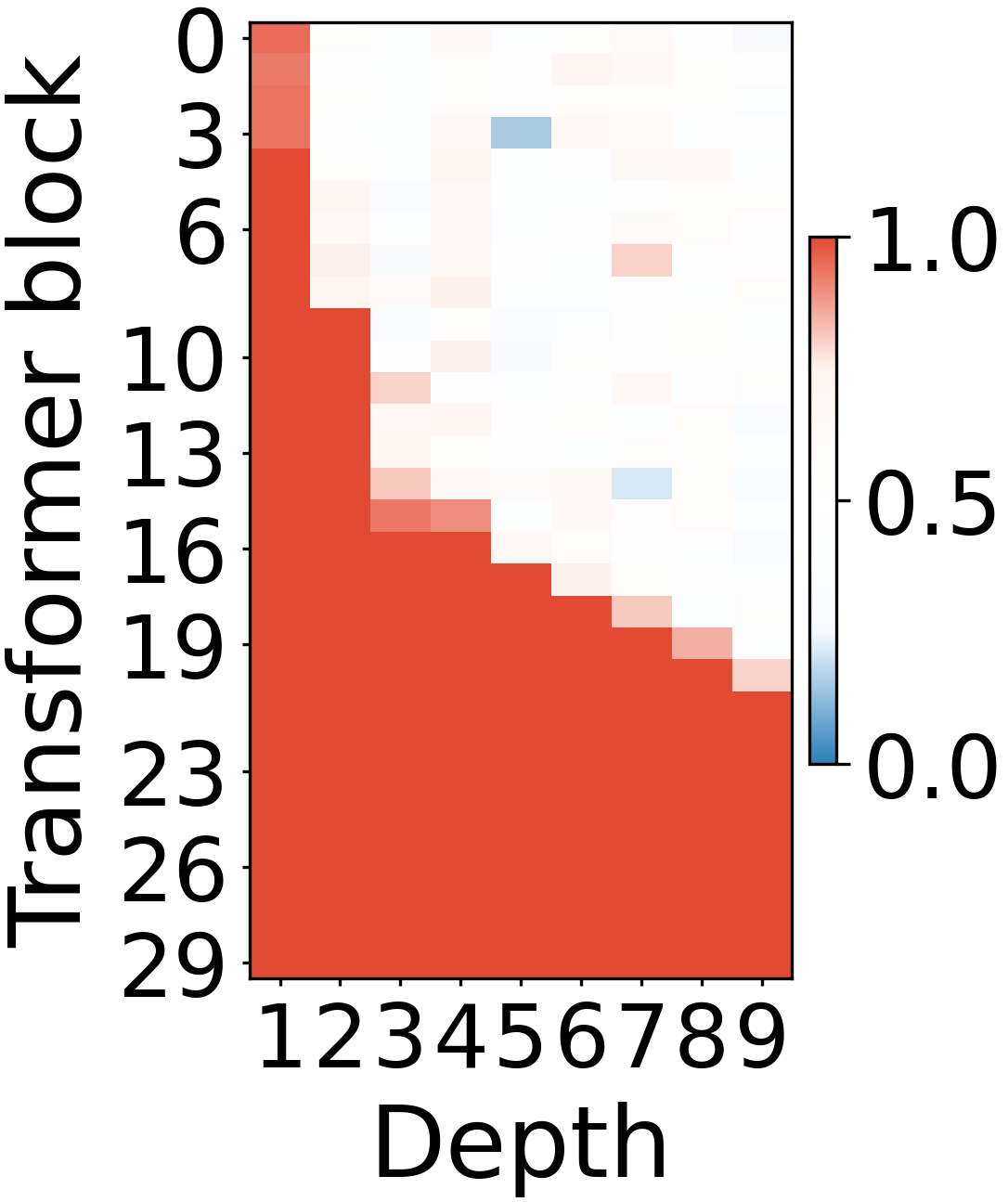
To quantitatively verify this process, we perform MLP probing to measure the amount of information each transformer layer stores about the rotational parity of individual gears relative to the driving gear.
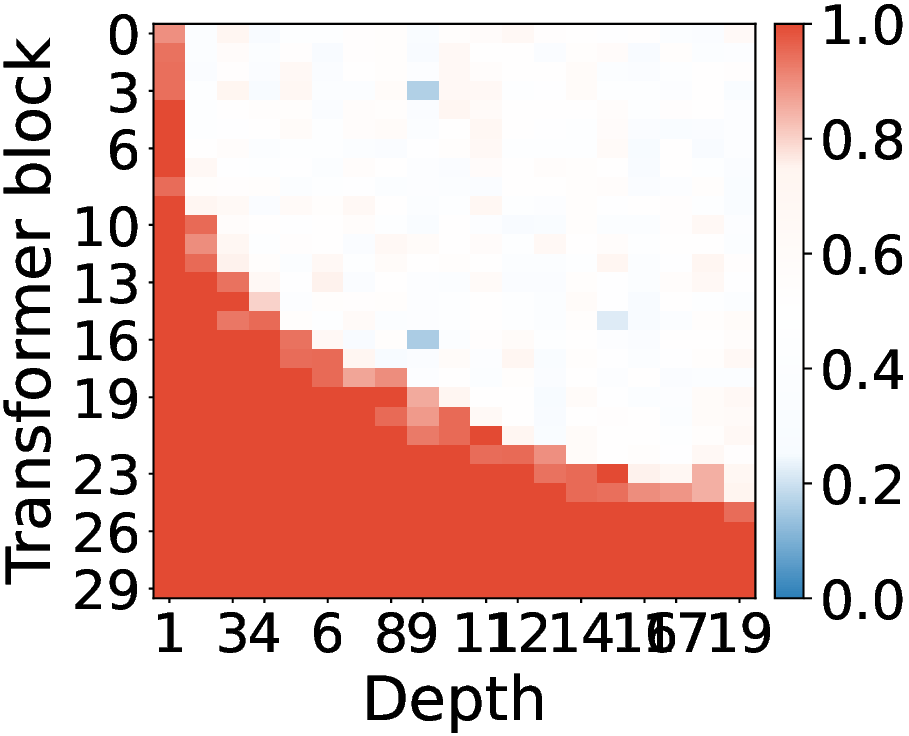
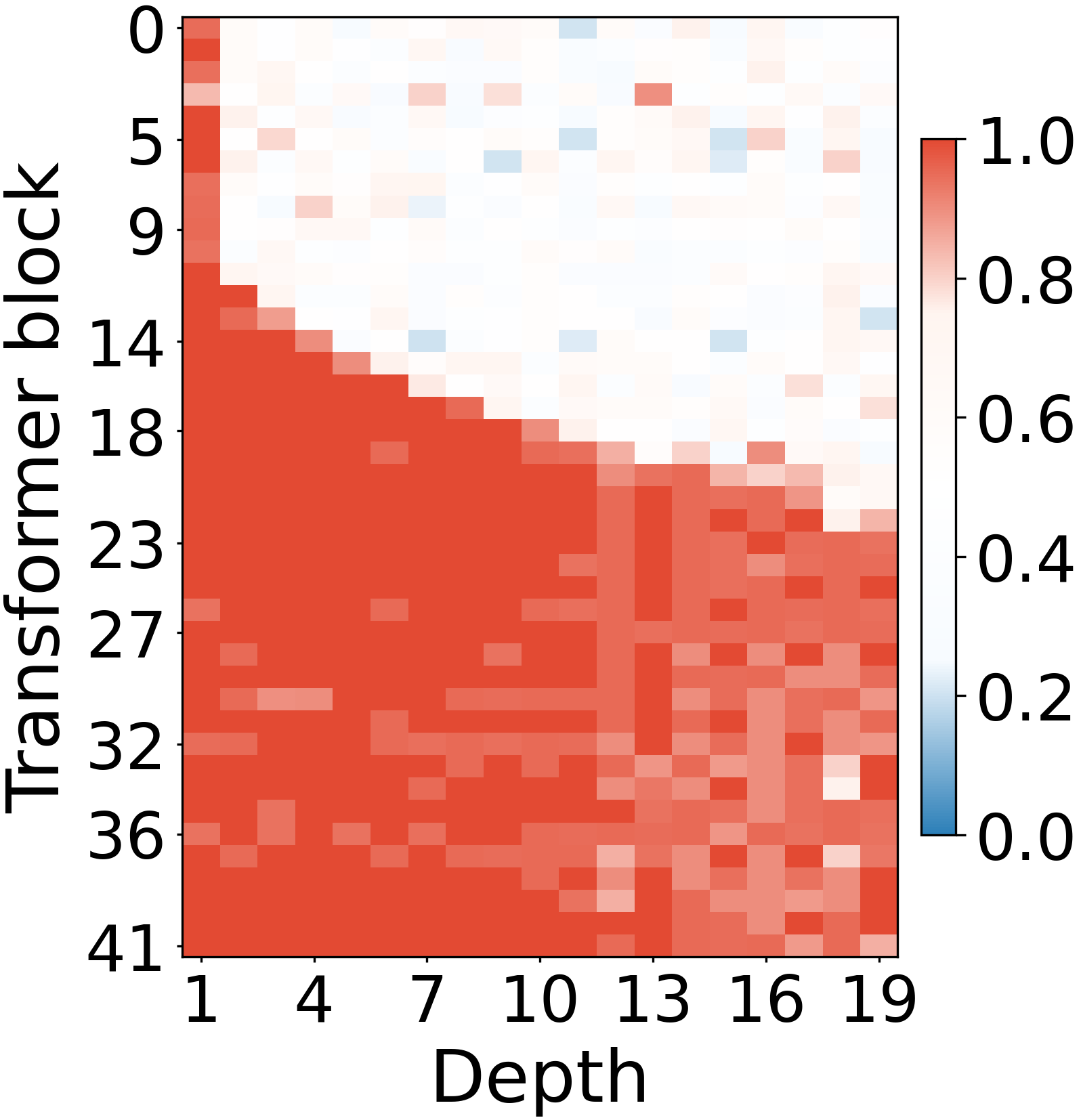
As shown in the heatmap below, the probing accuracy increases almost linearly with network depth, providing evidence that gear parity is determined incrementally across layers.
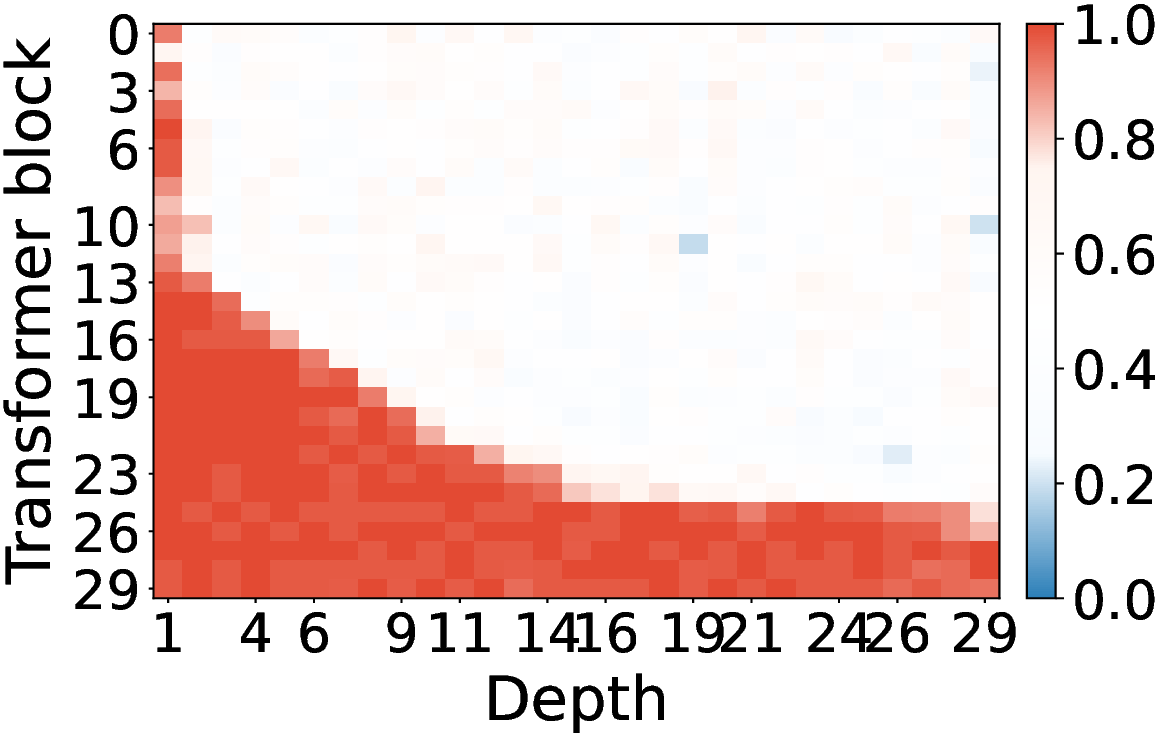
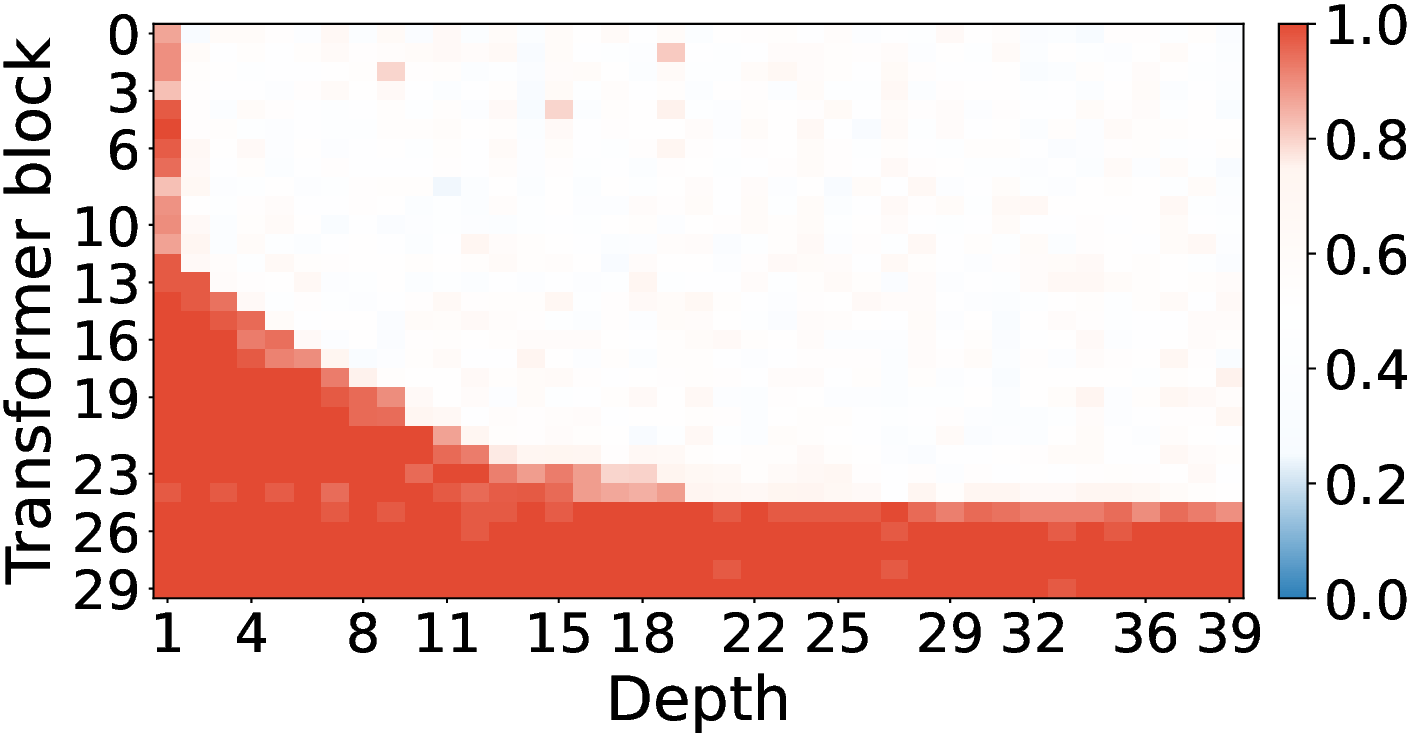
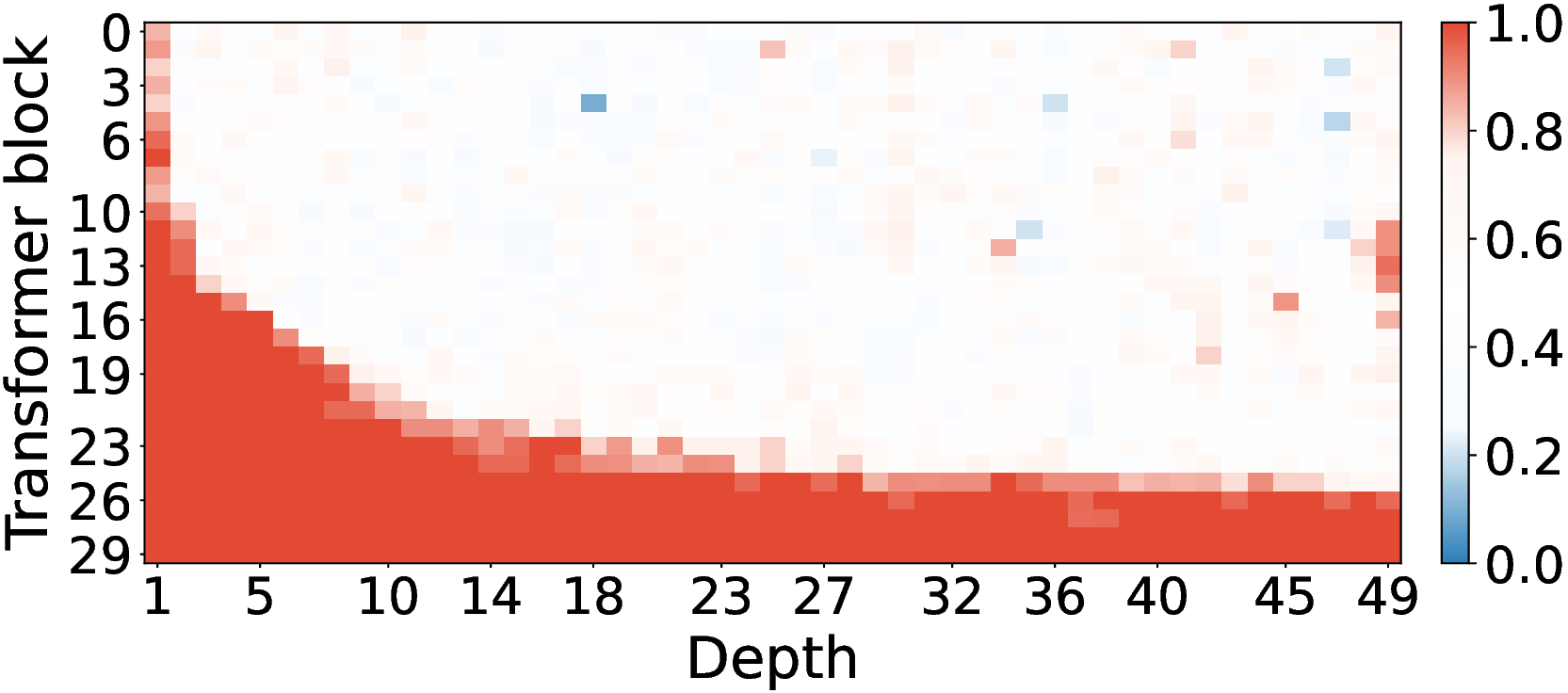
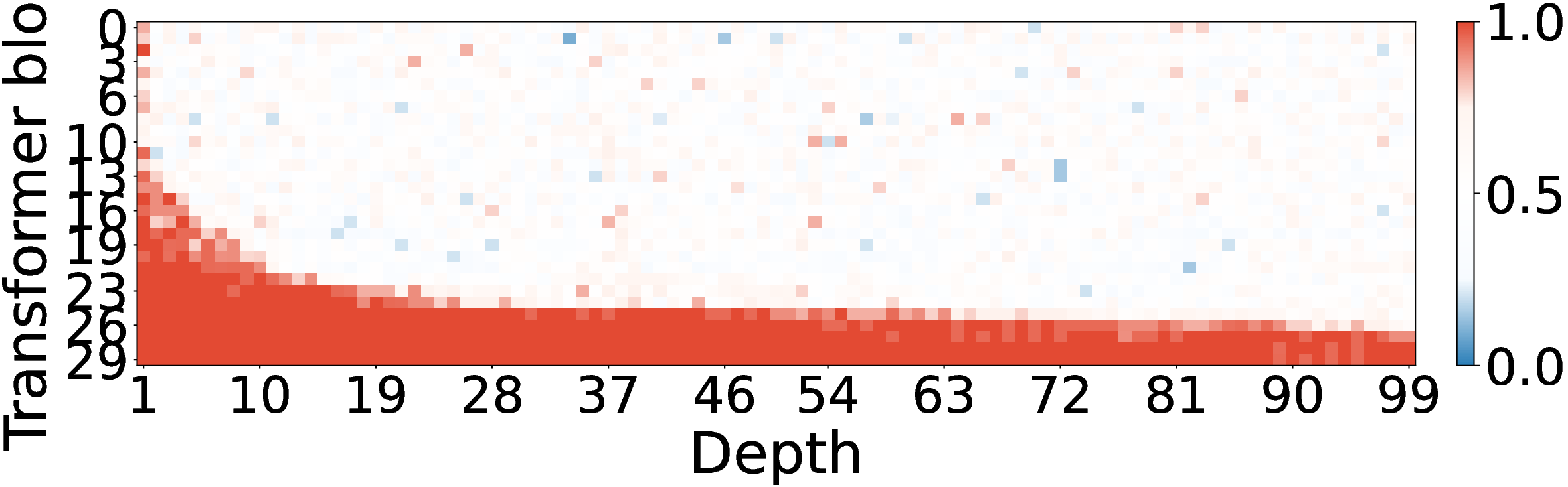
Note: The heatmaps report the probing accuracy for predicting the parity of each gear relative to the driving gear, across transformer blocks (vertical axis) and kinematic depth from the driving gear (horizontal axis).
1.3. O.O.D. Kinematic Height
Notably, the learned Parallel-BFS reasoning mechanisms generalize poorly to unseen kinematic heights. As shown in the table below, the model achieves a success rate of almost 0 on out-of-distribution cases when the kinematic height exceeds the training range.
| N | Kinematic height (h) | ||||
|---|---|---|---|---|---|
| 5 | 10 | 20 | 30 | 40 | |
| 5 | 100 | — | — | — | — |
| 10 | 100 | 3 | — | — | — |
| 20 | 94 | 0 | 0 | — | — |
| 30 | 96 | 0 | 0 | 0 | — |
| 40 | 88 | 0 | 0 | 0 | 0 |
| N | Kinematic height (h) | |||||||||
|---|---|---|---|---|---|---|---|---|---|---|
| 10 | 20 | 30 | 40 | 50 | 60 | 70 | 80 | 90 | 100 | |
| 10 | 100 | — | — | — | — | — | — | — | — | — |
| 20 | 100 | 1 | — | — | — | — | — | — | — | — |
| 30 | 97 | 1 | 0 | — | — | — | — | — | — | — |
| 40 | 100 | 0 | 0 | 0 | — | — | — | — | — | — |
| 50 | 94 | 0 | 0 | 0 | 0 | — | — | — | — | — |
| 60 | 90 | 0 | 0 | 0 | 0 | 0 | — | — | — | — |
| 70 | 100 | 0 | 0 | 0 | 0 | 0 | 0 | — | — | — |
| 80 | 99 | 0 | 0 | 0 | 0 | 0 | 0 | 0 | — | — |
| 90 | 89 | 0 | 0 | 0 | 0 | 0 | 0 | 0 | 0 | — |
| 100 | 82 | 0 | 0 | 0 | 0 | 0 | 0 | 0 | 0 | 0 |
Feature probing on out-of-distribution kinematic heights
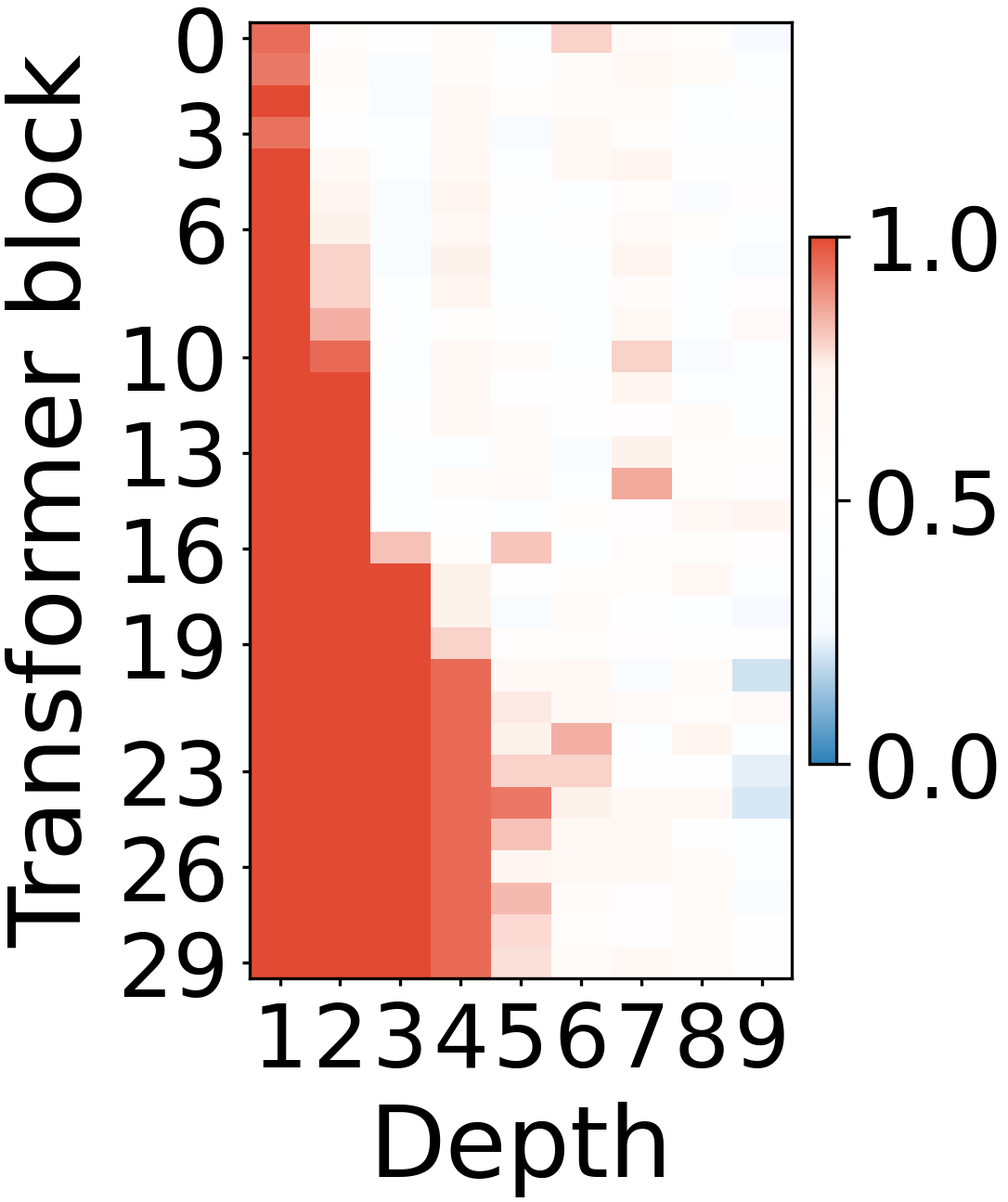
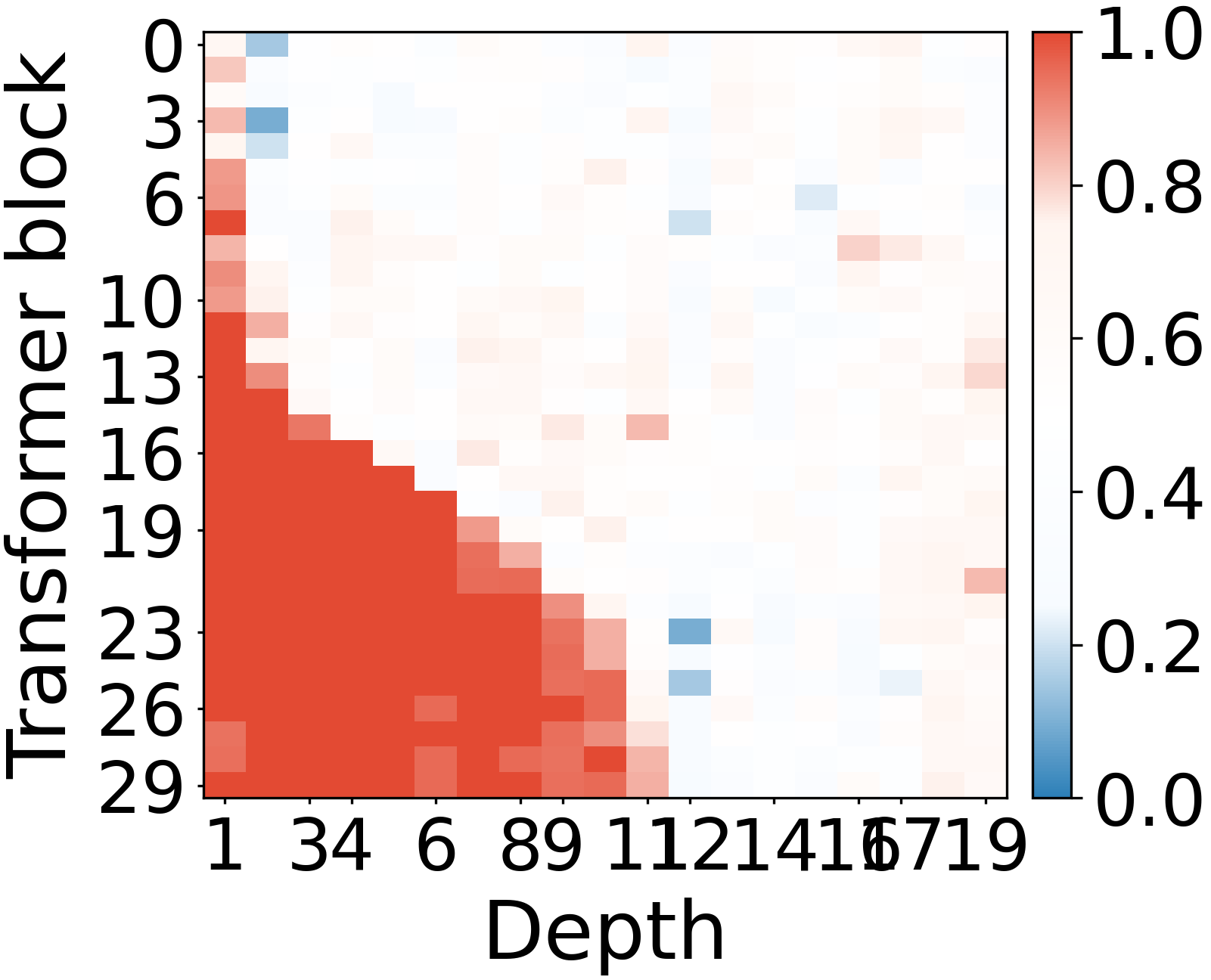
Feature probing below also reveals that the model successfully propagates parity information across transformer layers up to the height observed during training, but that this iterative propagation ceases beyond that height.
O.O.D. failure examples
1.4. I.D. Kinematic Height
The model can generalize to unseen gear counts and branching factors as long as the kinematic height remains within the training distribution. As shown in the tables below, the model performs well on mechanisms containing 100 gears, despite being trained only on mechanisms with up to 10 gears, provided that the kinematic height remains in-distribution (i.e. h = 10).
| N | Kinematic height (h) | ||||
|---|---|---|---|---|---|
| 5 | 10 | 20 | 30 | 40 | |
| 5 | 100 | — | — | — | — |
| 10 | 100 | 3 | — | — | — |
| 20 | 94 | 0 | 0 | — | — |
| 30 | 96 | 0 | 0 | 0 | — |
| 40 | 88 | 0 | 0 | 0 | 0 |
| N | Kinematic height (h) | |||||||||
|---|---|---|---|---|---|---|---|---|---|---|
| 10 | 20 | 30 | 40 | 50 | 60 | 70 | 80 | 90 | 100 | |
| 10 | 100 | — | — | — | — | — | — | — | — | — |
| 20 | 100 | 1 | — | — | — | — | — | — | — | — |
| 30 | 97 | 1 | 0 | — | — | — | — | — | — | — |
| 40 | 100 | 0 | 0 | 0 | — | — | — | — | — | — |
| 50 | 94 | 0 | 0 | 0 | 0 | — | — | — | — | — |
| 60 | 90 | 0 | 0 | 0 | 0 | 0 | — | — | — | — |
| 70 | 100 | 0 | 0 | 0 | 0 | 0 | 0 | — | — | — |
| 80 | 99 | 0 | 0 | 0 | 0 | 0 | 0 | 0 | — | — |
| 90 | 89 | 0 | 0 | 0 | 0 | 0 | 0 | 0 | 0 | — |
| 100 | 82 | 0 | 0 | 0 | 0 | 0 | 0 | 0 | 0 | 0 |
100-Gear Examples (Trained on Mechanisms with Up to 10 Gears, Applied to 100-Gear Mechanisms at Kinematic Height 10)
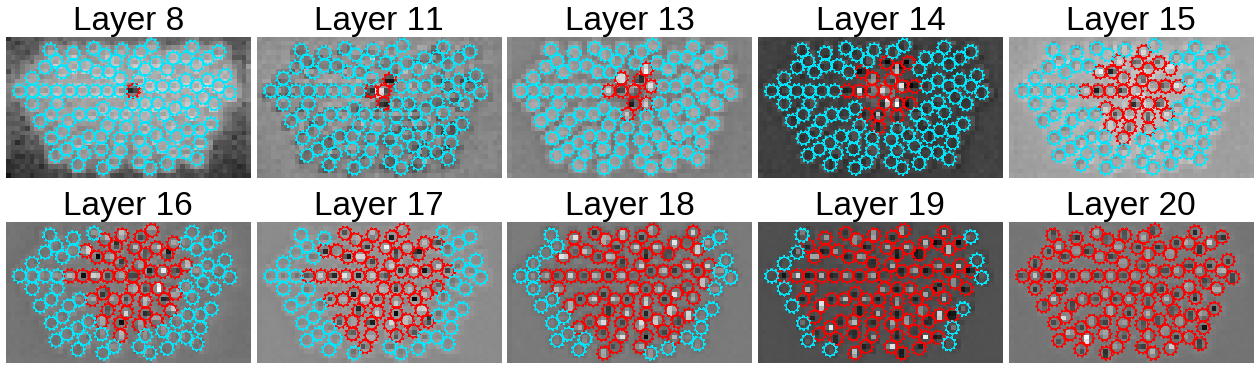
Parity propagation scales to 100 gears at height 10
The parallel-BFS-like feature progression appears on 100 gears even when the model is trained only up to 10 Gears.
Generalization to unseen tree topologies
we train the model exclusively on gear mechanisms forming linear kinematic chains, in which each interior gear has exactly two neighboring gears. Interetingly, the trained model still performs well on arbitrary tree topologies during inference as demonstrated below.
| Training bound | Linear chain (I.D.) | General tree (O.O.D.) | ||
|---|---|---|---|---|
| SSR ↑ | Ermd ↓ | SSR ↑ | Ermd ↓ | |
| Ntrain, htrain ≤ 5 | 100% | 0.058 | 100% | 0.058 |
| Ntrain, htrain ≤ 10 | 97% | 0.046 | 99% | 0.040 |
Unseen-topology examples (Trained on linear graph, tested on general graph)
PCA analysis on unseen kinematic topologies.
The transformer layers successfully propagate parity information to previously unseen numbers of neighboring gears in parallel.
We next demonstrate the emergence of divide-and-conquer-like reasoning by training models on gear mechanisms with numbers of gears and kinematic heights up to 50. Notably, our video DiT contains only 30 transformer layers. Therefore, a straightforward parallel BFS strategy is infeasible.
2.1. PCA Analysis
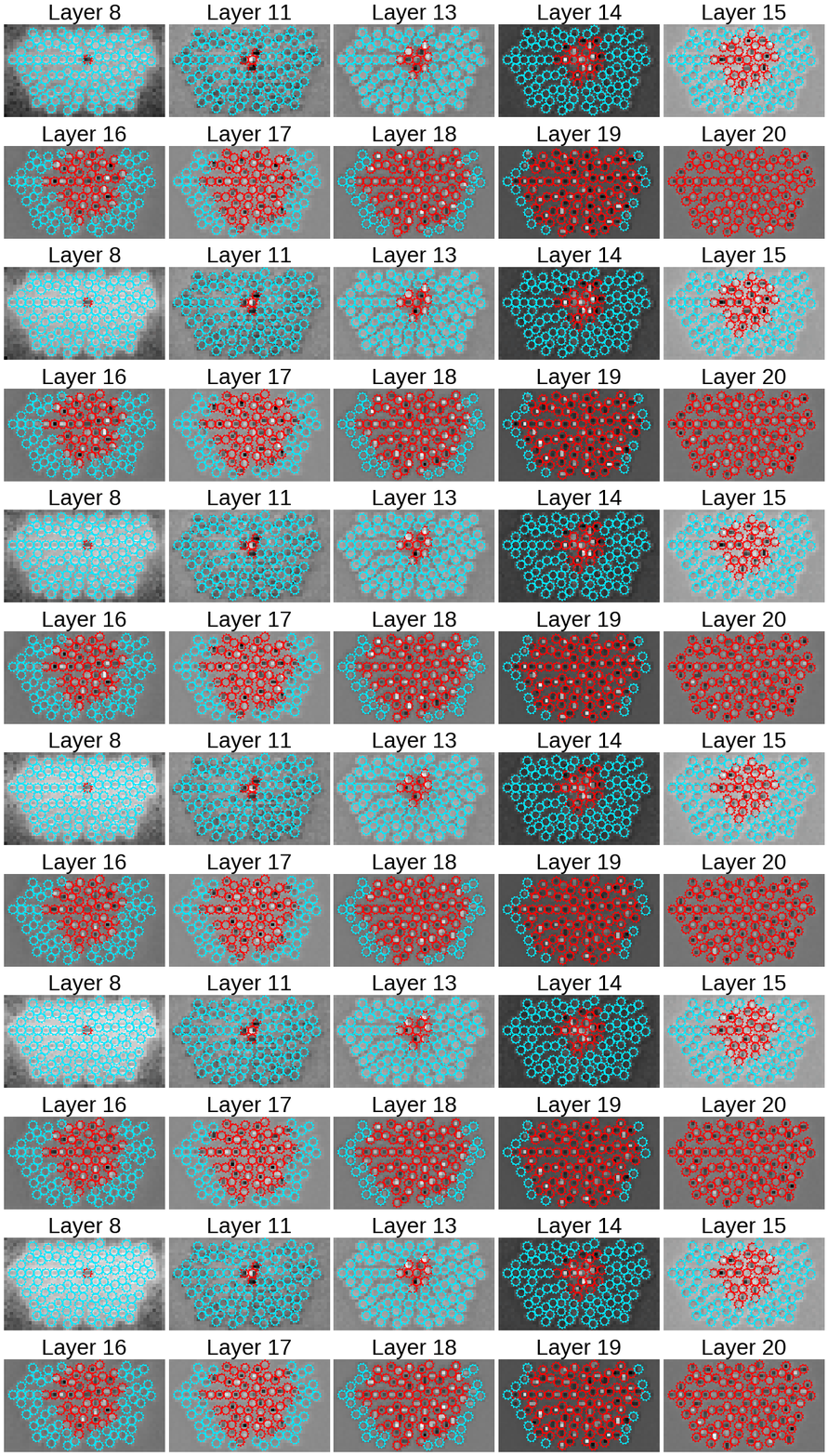
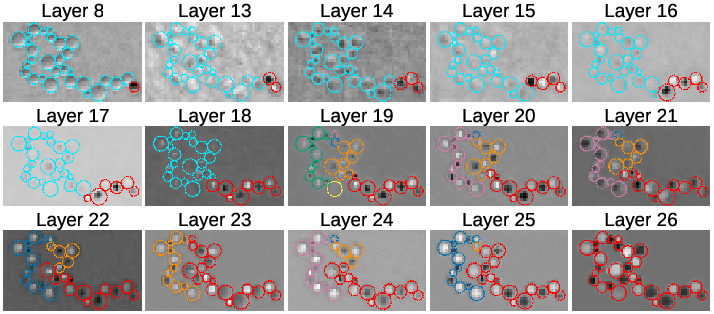
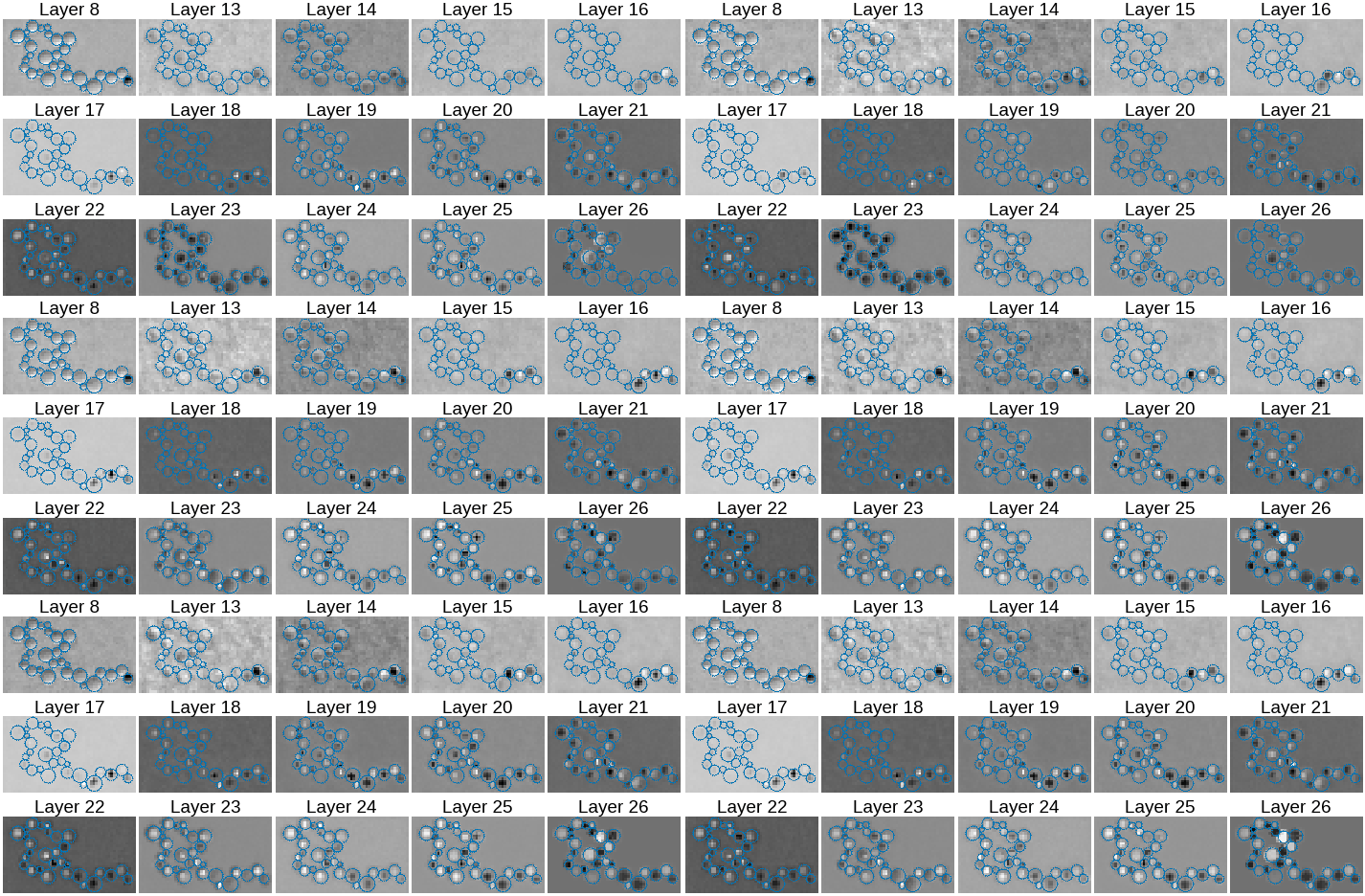
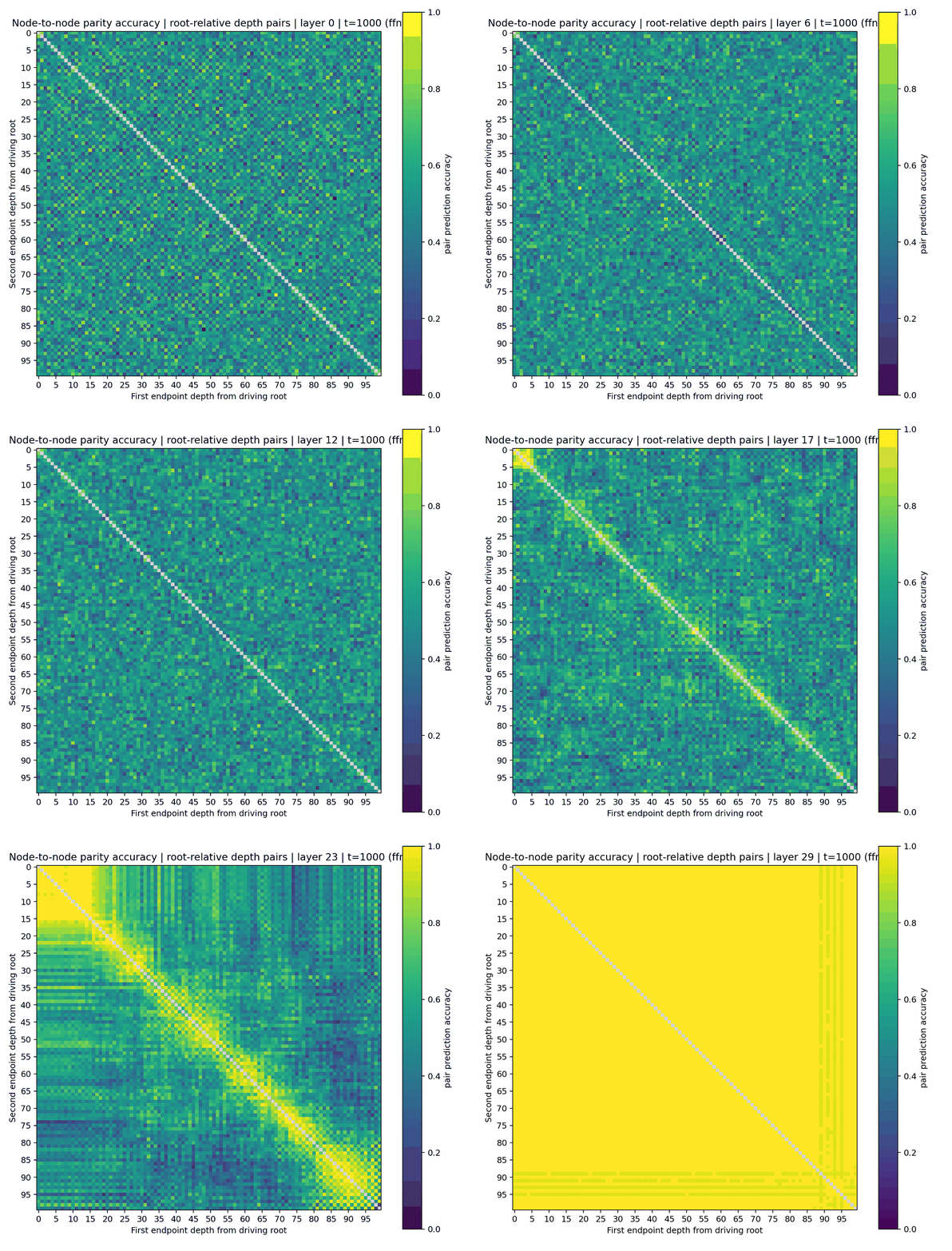
Our PCA analysis below reveals an intriguing departure from the short-chain setting. In the early layers, we continue to observe the parallel BFS pattern. However, in mid-late layers, parity signals begin to emerge simultaneously in gears that have not yet been reached by the BFS process. Importantly, these newly emerging signals are initially consistent only within their respective neighborhoods, but subsequently become globally consistent.
Layer-wise PCA visualization
2.2.1. Root-relative MLP Probing
MLP probing provides further evidence for this behavior. In the shallow layers, probing accuracy for the relative parity between the driving gear and each gear increases approximately linearly with kinematic depth. In later layers, however, the accuracy increases rapidly.
2.2.2. Pairwise MLP Probing
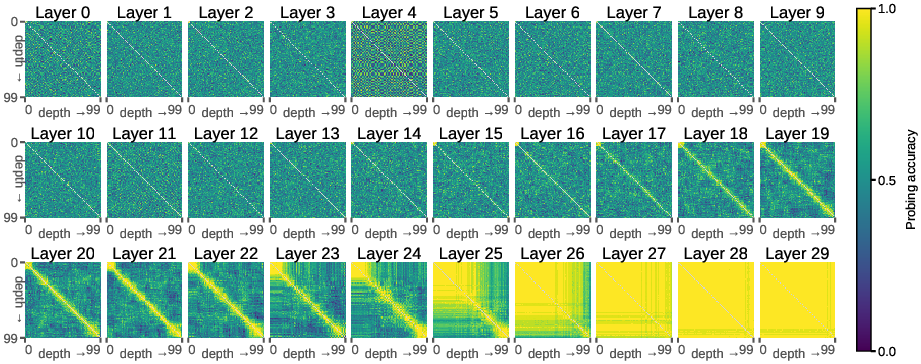
The matrix below visualizes the per-layer pairwise parity prediction accuracy across the linear gear chain. When the model is trained on larger gear counts (e.g., 20, 30, ...), we observe the formation of clusters in which parity predictions are highly accurate locally but remain globally inconsistent. In later layers, these local clusters progressively merge, ultimately yielding a globally consistent parity representation.
Pairwise parity prediction accuracy across transformer layers
Trained through N, h ≤ 5 and evaluated on a linear chain of height 5.
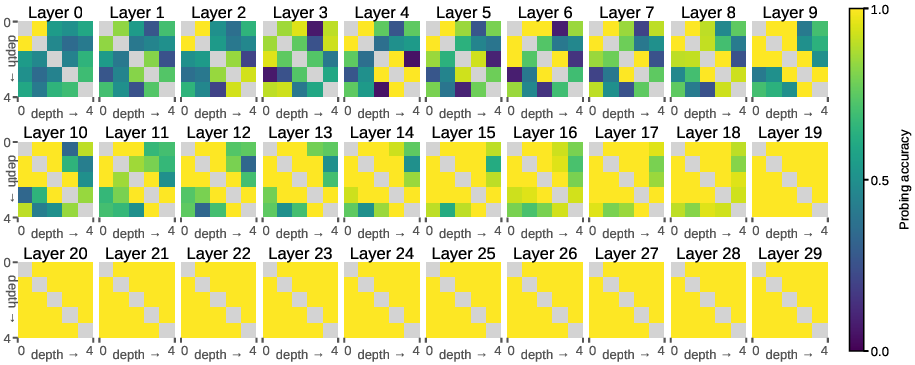
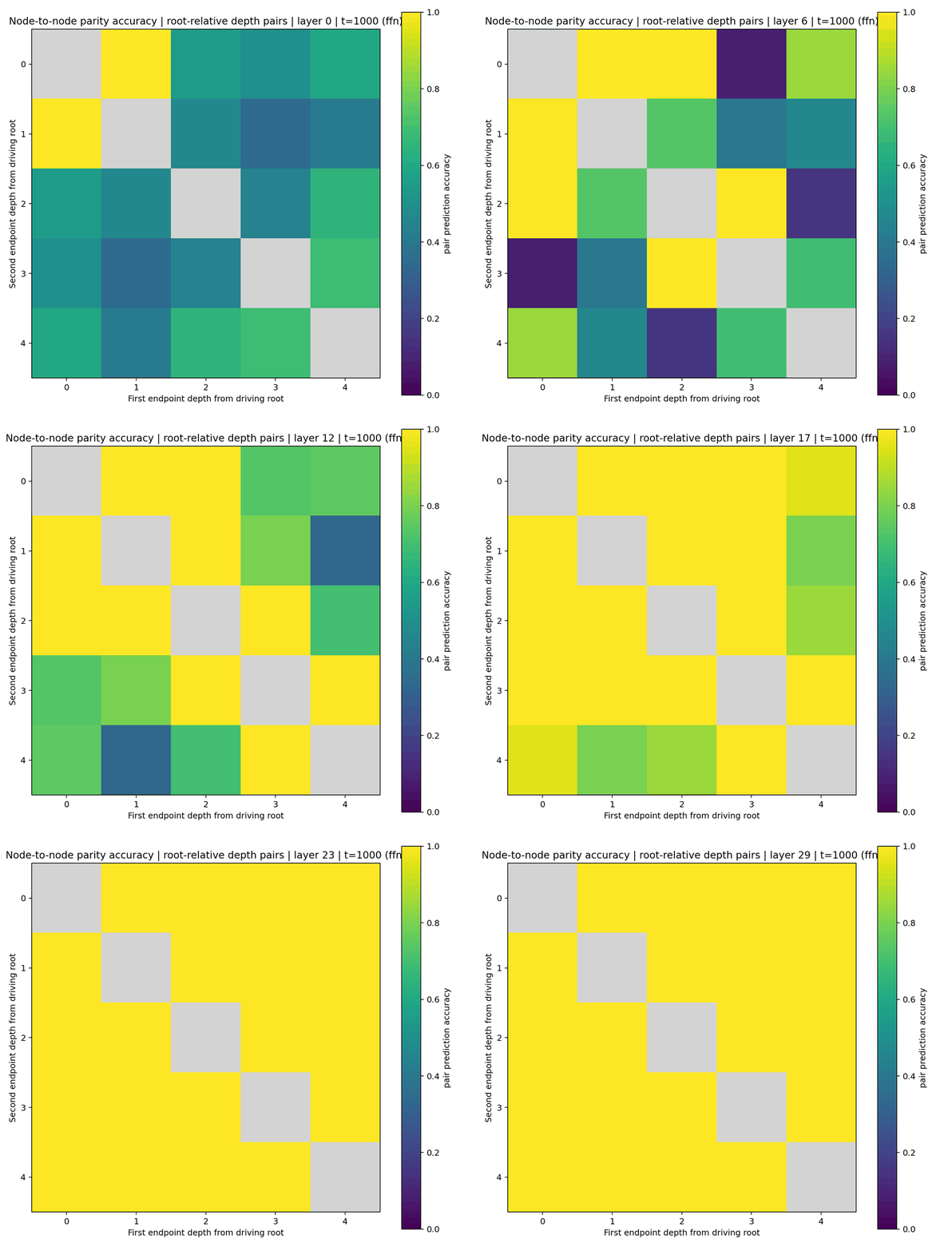
Pairwise parity prediction accuracy across transformer layers
Trained through N, h ≤ 10 and evaluated on a linear chain of height 10.
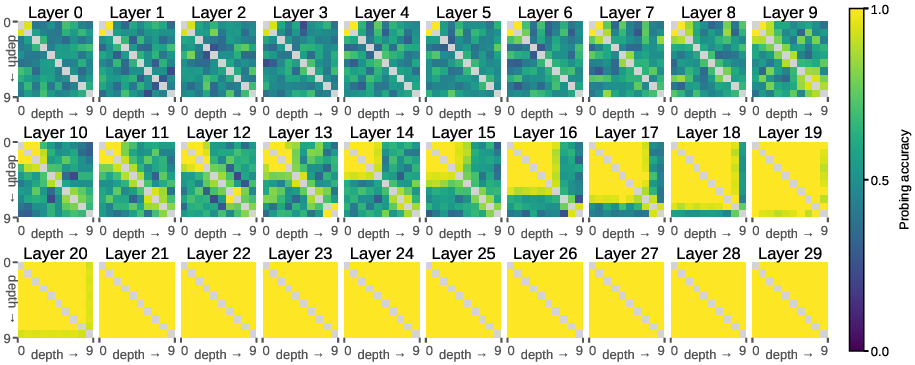
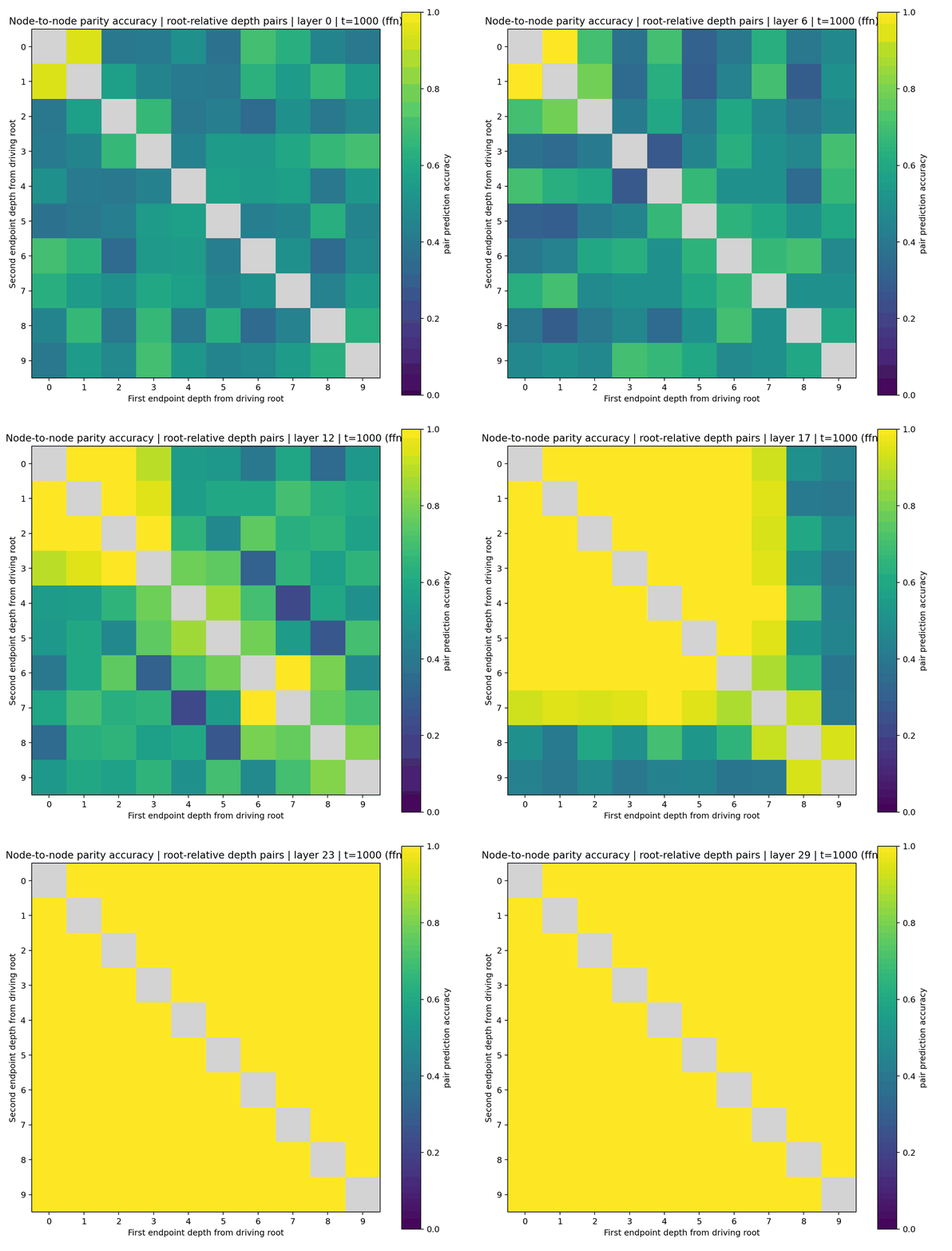
Pairwise parity prediction accuracy across transformer layers
Trained through N, h ≤ 20 and evaluated on a linear chain of height 20.
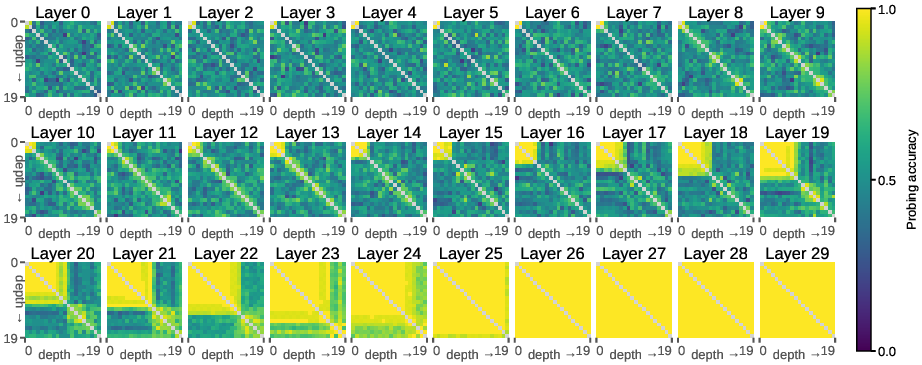
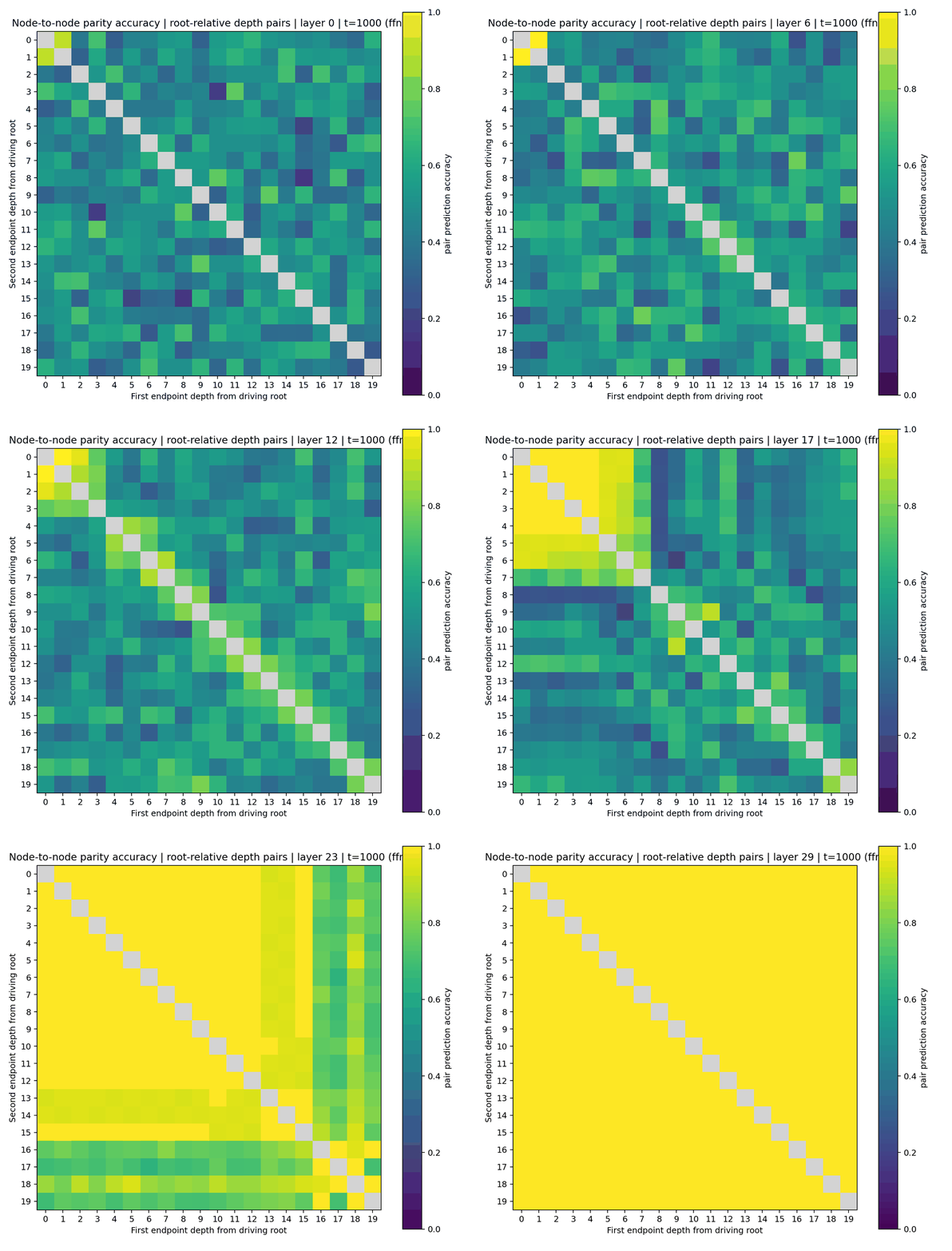
Pairwise parity prediction accuracy across transformer layers
Trained through N, h ≤ 30 and evaluated on a linear chain of height 30.
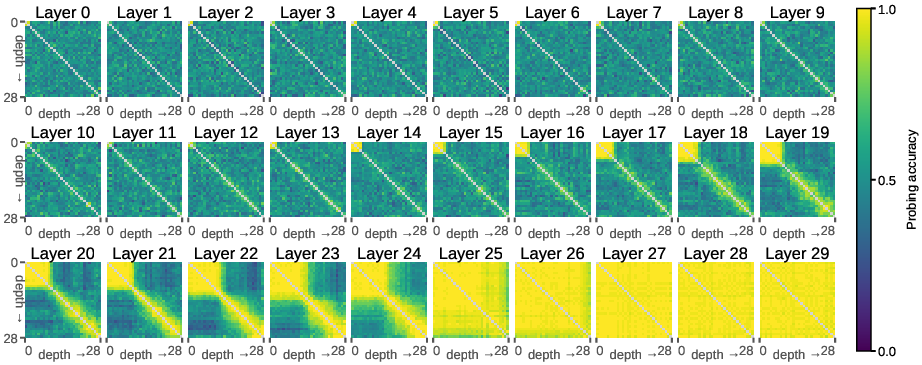
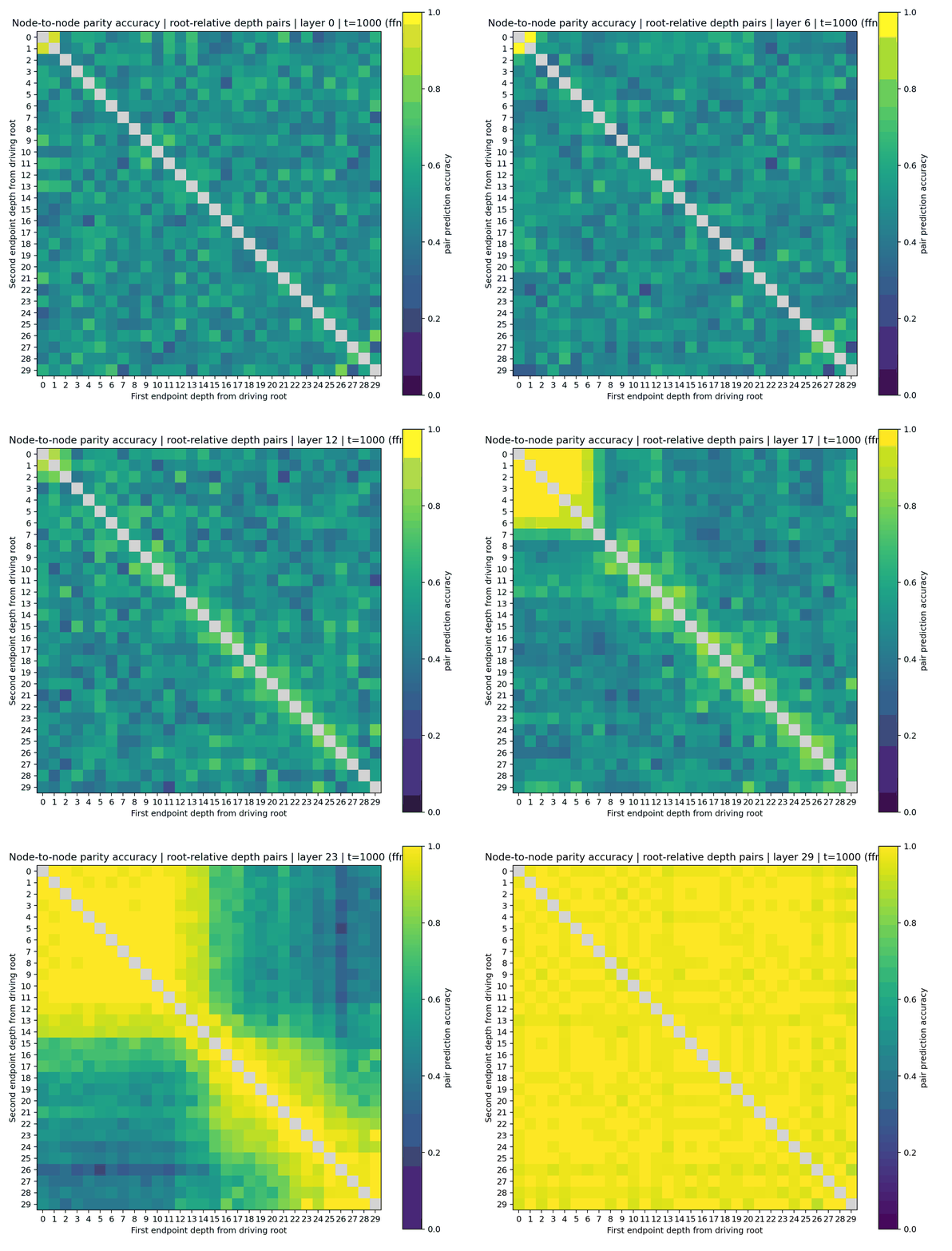
Pairwise parity prediction accuracy across transformer layers
Trained through N, h ≤ 40 and evaluated on a linear chain of height 40.
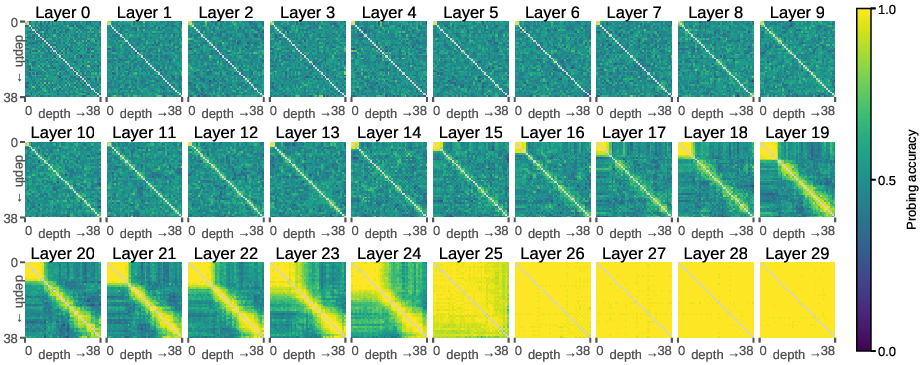
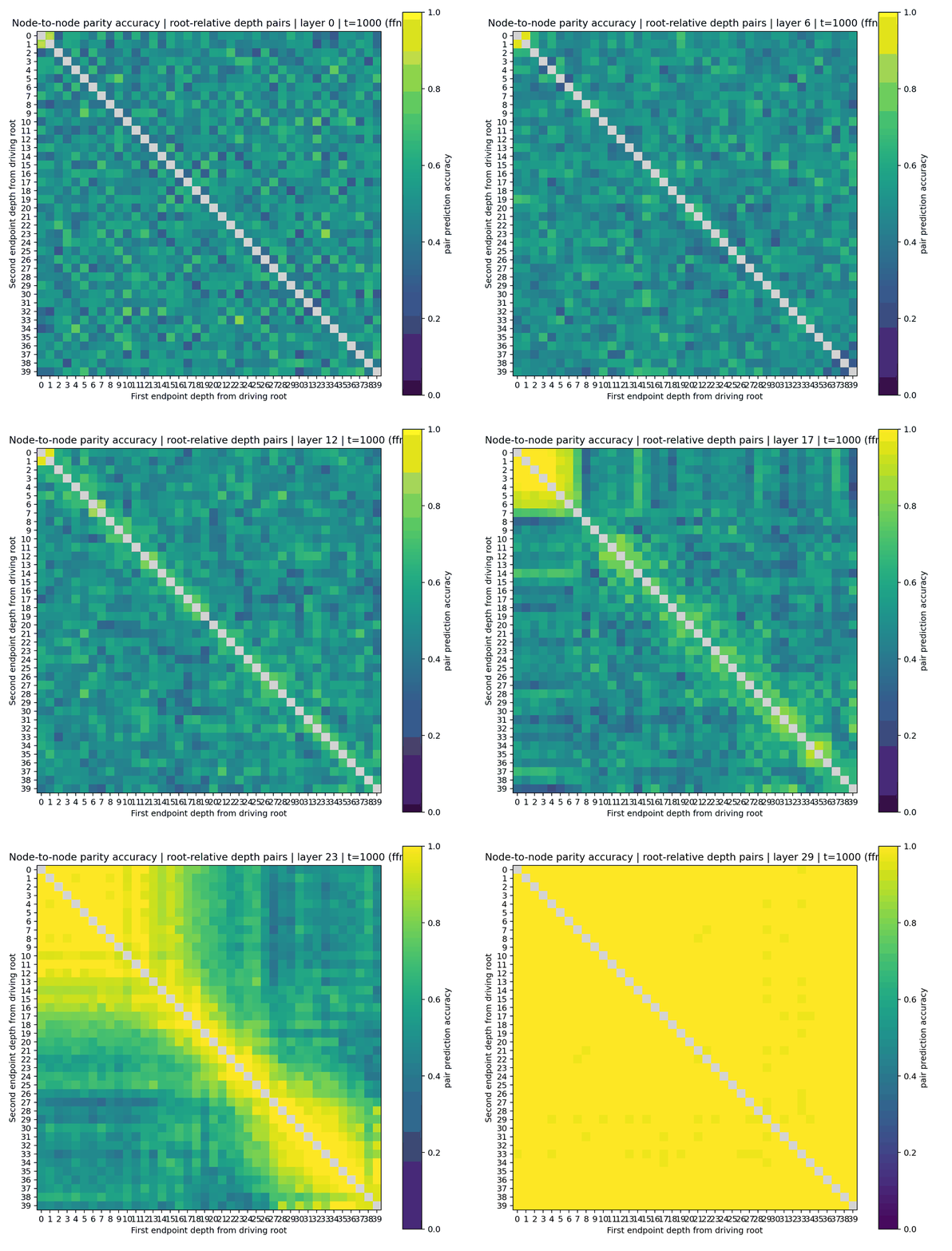
Pairwise parity prediction accuracy across transformer layers
Trained through N, h ≤ 50 and evaluated on a linear chain of height 50.
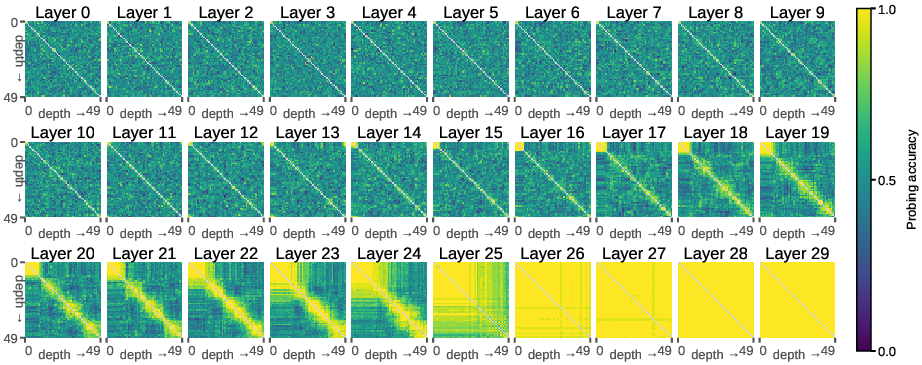
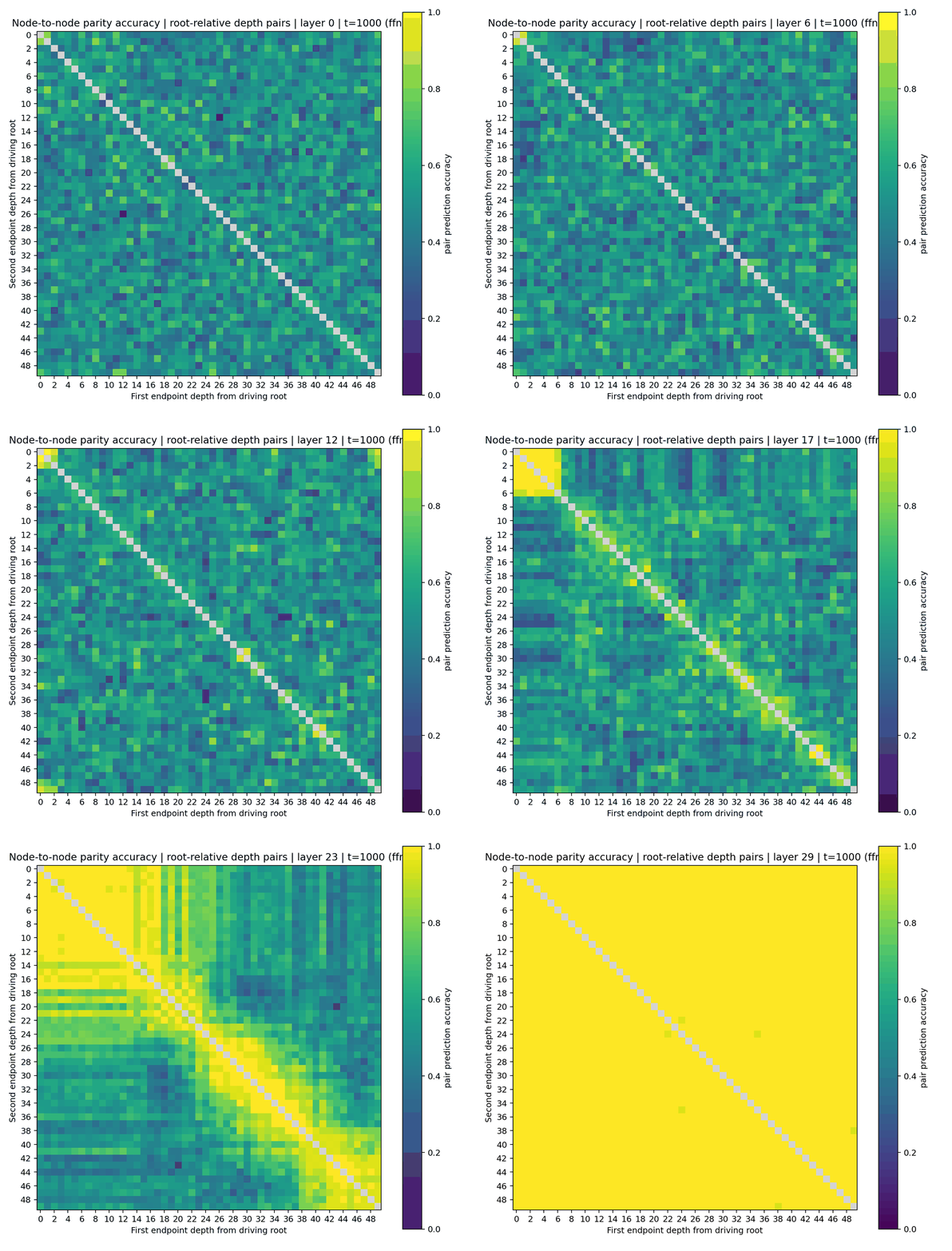
Pairwise parity prediction accuracy across transformer layers
Trained through N, h ≤ 100 and evaluated on a linear chain of height 100.
2.3. Generalizability
The learned divide-and-conquer strategy does not exhibit the same degree of generalizability as the parallel BFS strategy. As shown below, we observe weaker generalization to unseen gear counts, even when the kinematic height remains within the training distribution. The main exception is when the kinematic height is up to around $10$, where the model continues to generalize. This is because the model can still rely on parallel BFS reasoning. Another notable difference is that the model starts exhibiting non-zero success rates on unseen kinematic heights, which was not the case in experiments with shorter kinematic chains.
Training: Ntrain, htrain ≤ 20
| N | Test kinematic height h | |||||||||
|---|---|---|---|---|---|---|---|---|---|---|
| 10 | 20 | 30 | 40 | 50 | 60 | 70 | 80 | 90 | 100 | |
| 10 | 100 | — | — | — | — | — | — | — | — | — |
| 20 | 100 | 100 | — | — | — | — | — | — | — | — |
| 30 | 100 | 99 | 68 | — | — | — | — | — | — | — |
| 40 | 99 | 98 | 63 | 42 | — | — | — | — | — | — |
| 50 | 98 | 86 | 49 | 23 | 12 | — | — | — | — | — |
| 60 | 98 | 80 | 33 | 18 | 9 | 6 | — | — | — | — |
| 70 | 100 | 70 | 22 | 16 | 12 | 7 | 2 | — | — | — |
| 80 | 100 | 54 | 19 | 7 | 10 | 3 | 2 | 3 | — | — |
| 90 | 100 | 46 | 10 | 5 | 4 | 7 | 2 | 3 | 0 | — |
| 100 | 97 | 28 | 15 | 4 | 5 | 1 | 2 | 1 | 3 | 4 |
Training: Ntrain, htrain ≤ 30
| N | Test kinematic height h | |||||||||
|---|---|---|---|---|---|---|---|---|---|---|
| 10 | 20 | 30 | 40 | 50 | 60 | 70 | 80 | 90 | 100 | |
| 10 | 100 | — | — | — | — | — | — | — | — | — |
| 20 | 100 | 99 | — | — | — | — | — | — | — | — |
| 30 | 99 | 99 | 97 | — | — | — | — | — | — | — |
| 40 | 99 | 99 | 94 | 84 | — | — | — | — | — | — |
| 50 | 99 | 98 | 86 | 74 | 58 | — | — | — | — | — |
| 60 | 97 | 88 | 78 | 66 | 47 | 32 | — | — | — | — |
| 70 | 100 | 80 | 72 | 37 | 34 | 30 | 14 | — | — | — |
| 80 | 100 | 70 | 59 | 31 | 27 | 16 | 11 | 12 | — | — |
| 90 | 100 | 68 | 47 | 24 | 24 | 12 | 16 | 5 | 2 | — |
| 100 | 98 | 53 | 38 | 24 | 15 | 7 | 7 | 3 | 5 | 3 |
Training: Ntrain, htrain ≤ 40
| N | Test kinematic height h | |||||||||
|---|---|---|---|---|---|---|---|---|---|---|
| 10 | 20 | 30 | 40 | 50 | 60 | 70 | 80 | 90 | 100 | |
| 10 | 99 | — | — | — | — | — | — | — | — | — |
| 20 | 99 | 99 | — | — | — | — | — | — | — | — |
| 30 | 99 | 100 | 100 | — | — | — | — | — | — | — |
| 40 | 100 | 99 | 100 | 97 | — | — | — | — | — | — |
| 50 | 99 | 97 | 98 | 96 | 84 | — | — | — | — | — |
| 60 | 98 | 90 | 88 | 86 | 66 | 54 | — | — | — | — |
| 70 | 100 | 96 | 81 | 60 | 44 | 47 | 30 | — | — | — |
| 80 | 100 | 92 | 78 | 58 | 46 | 31 | 25 | 17 | — | — |
| 90 | 100 | 83 | 69 | 51 | 43 | 31 | 23 | 20 | 10 | — |
| 100 | 99 | 84 | 71 | 40 | 35 | 16 | 12 | 10 | 9 | 6 |
Training: Ntrain, htrain ≤ 50
| N | Test kinematic height h | |||||||||
|---|---|---|---|---|---|---|---|---|---|---|
| 10 | 20 | 30 | 40 | 50 | 60 | 70 | 80 | 90 | 100 | |
| 10 | 100 | — | — | — | — | — | — | — | — | — |
| 20 | 100 | 100 | — | — | — | — | — | — | — | — |
| 30 | 99 | 100 | 100 | — | — | — | — | — | — | — |
| 40 | 99 | 100 | 100 | 100 | — | — | — | — | — | — |
| 50 | 99 | 99 | 97 | 98 | 95 | — | — | — | — | — |
| 60 | 99 | 95 | 97 | 96 | 95 | 85 | — | — | — | — |
| 70 | 100 | 99 | 89 | 67 | 56 | 54 | 43 | — | — | — |
| 80 | 100 | 97 | 84 | 62 | 57 | 42 | 35 | 31 | — | — |
| 90 | 100 | 90 | 74 | 63 | 46 | 38 | 29 | 25 | 19 | — |
| 100 | 99 | 92 | 73 | 47 | 35 | 20 | 23 | 13 | 15 | 5 |
Training: Ntrain, htrain ≤ 100
| N | Test kinematic height h | |||||||||
|---|---|---|---|---|---|---|---|---|---|---|
| 10 | 20 | 30 | 40 | 50 | 60 | 70 | 80 | 90 | 100 | |
| 10 | 99 | — | — | — | — | — | — | — | — | — |
| 20 | 100 | 98 | — | — | — | — | — | — | — | — |
| 30 | 99 | 100 | 100 | — | — | — | — | — | — | — |
| 40 | 100 | 99 | 99 | 100 | — | — | — | — | — | — |
| 50 | 99 | 96 | 97 | 95 | 97 | — | — | — | — | — |
| 60 | 96 | 95 | 92 | 97 | 98 | 96 | — | — | — | — |
| 70 | 100 | 99 | 97 | 97 | 93 | 91 | 98 | — | — | — |
| 80 | 99 | 100 | 98 | 92 | 93 | 94 | 86 | 99 | — | — |
| 90 | 100 | 100 | 96 | 94 | 90 | 84 | 90 | 84 | 98 | — |
| 100 | 100 | 99 | 95 | 93 | 90 | 87 | 83 | 87 | 86 | 89 |
To test whether our findings extend beyond Wan2.1-1.3B (a 30-layer DiT with cross-attention), we conducted additional experiments with CogVideoX-5B, a 42-layer MMDiT. Given the time and compute available during rebuttal, we partially fine-tuned CogVideoX-5B on gear systems with up to 20 gear counts and kinematic depth. Despite limited training, the MLP probing results below reveal the same linear trend observed in Wan2.1-1.3B (Figures 3.d and 4 in the paper) for kinematic heights up to approximately 10: parity prediction accuracy increases approximately linearly across transformer layers, which is characteristic of parallel BFS-like reasoning.
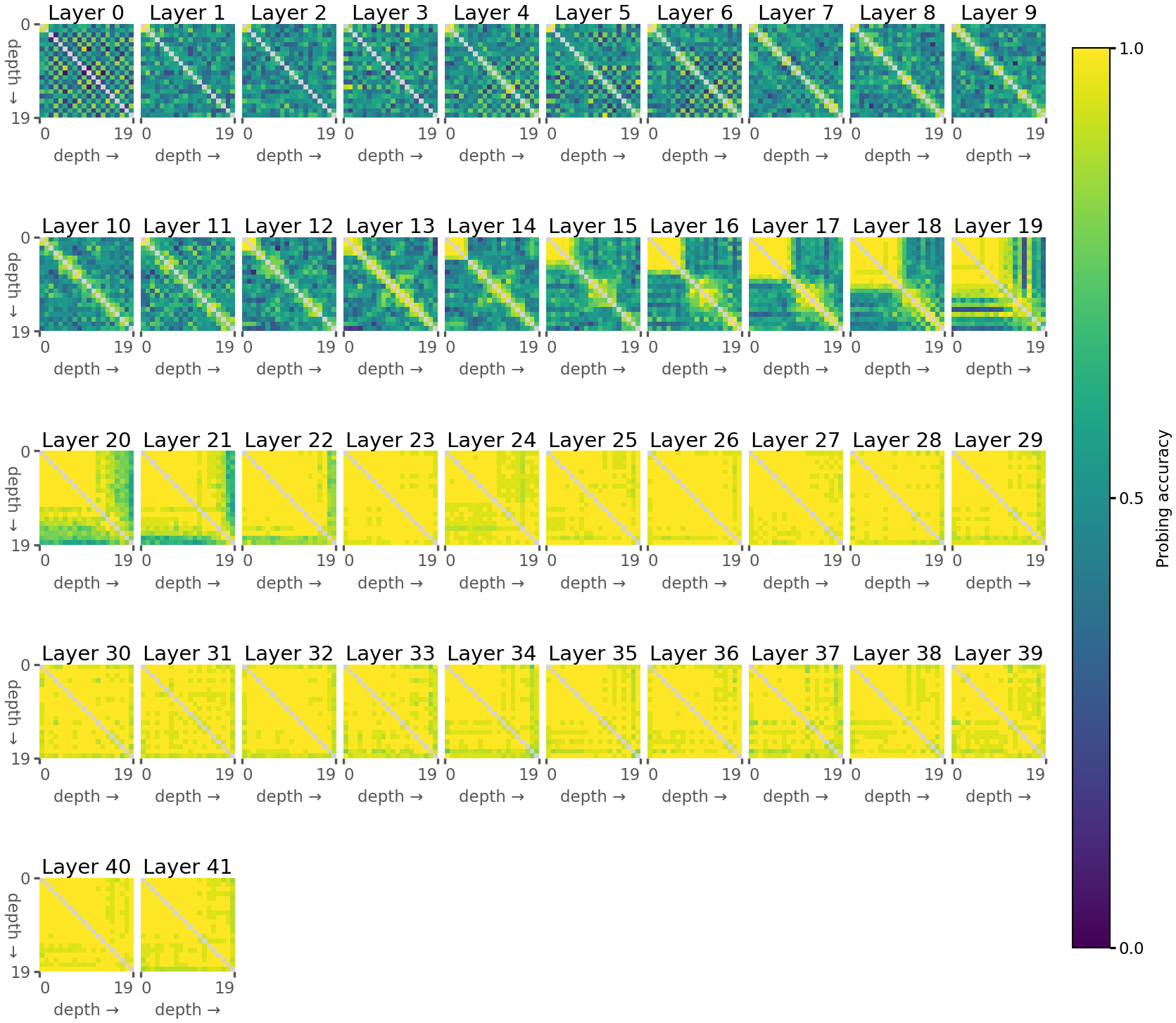
We also observe characteristics of divide-and-conquer-like reasoning around layer 16: clusters with locally accurate parity predictions emerge and merge in later layers.
Pairwise parity prediction accuracy across transformer layers
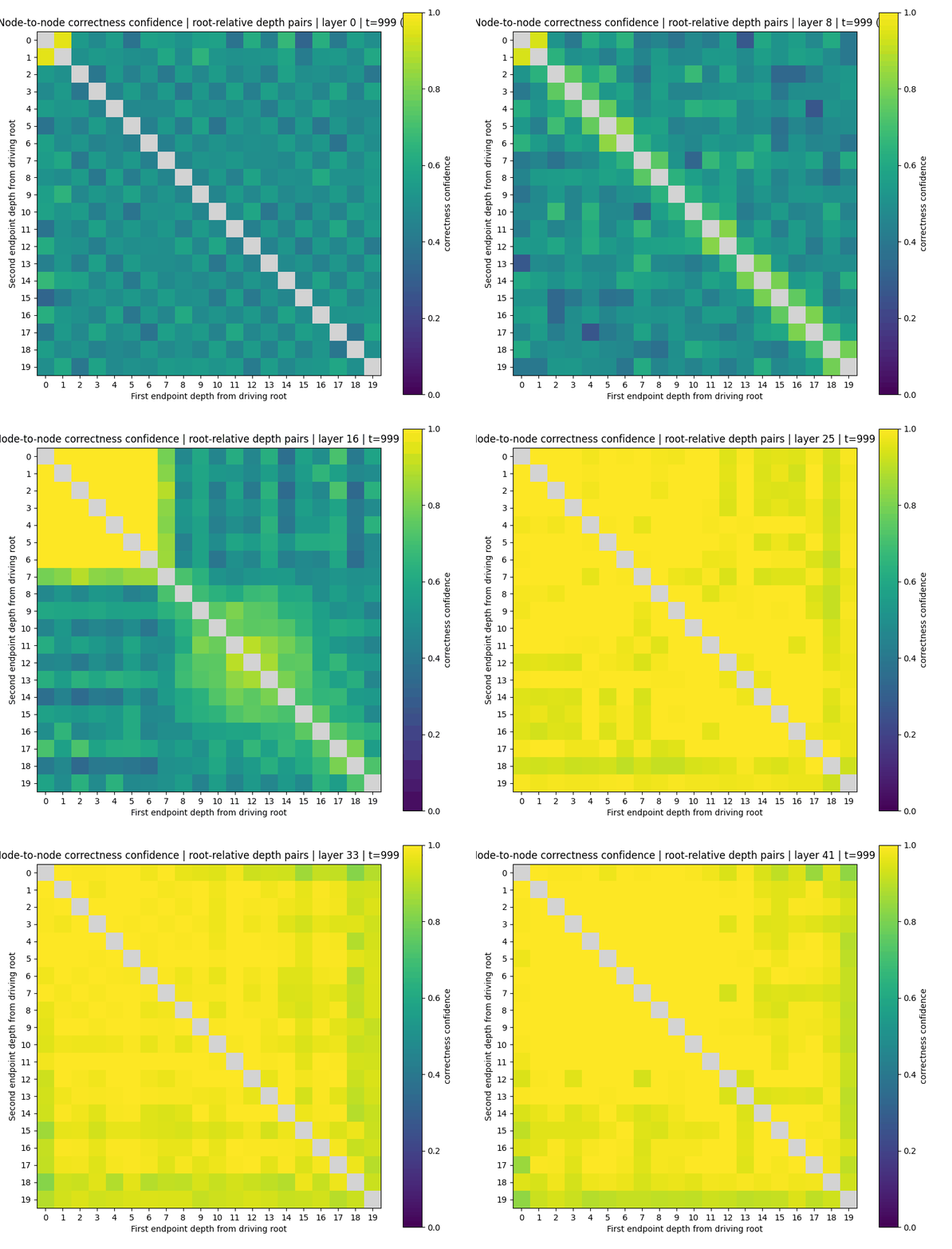
Furthermore, when evaluated on unseen gear counts (e.g., 70, 80, 90, and 100 gears), the partially trained model generalizes to in-distribution kinematic heights where it relies on parallel BFS-like reasoning (e.g., depth 10), but shows a moderate performance drop at kinematic heights where divide-and-conquer-like reasoning emerges (e.g., depth 20) and a significant performance drop at out-of-distribution kinematic heights (e.g., depth 40). These observations are consistent with our findings for Wan2.1-1.3B trained on kinematic heights up to 20, where both parallel BFS-like and divide-and-conquer-like reasoning emerge. Please note that training has not yet fully converged within the limited rebuttal budget, so the model has not yet achieved perfect performance in some in-distribution cases (e.g., 20 gears at depth 20). We will continue to update the supplemental webpage with further results as training progresses. Nevertheless, these preliminary results already confirm that our core findings are not specific to Wan2.1-1.3B.
| Kinematic depth | ||||||||||
|---|---|---|---|---|---|---|---|---|---|---|
| 10 | 20 | 30 | 40 | 50 | 60 | 70 | 80 | 90 | ||
| Number of Gears | 10 | 99 | — | — | — | — | — | — | — | — |
| 20 | 98 | 88 | — | — | — | — | — | — | — | |
| 30 | 97 | 82 | 37 | — | — | — | — | — | — | |
| 40 | 97 | 72 | 42 | 30 | — | — | — | — | — | |
| 50 | 93 | 60 | 39 | 21 | 14 | — | — | — | — | |
| 60 | 91 | 69 | 33 | 15 | 10 | 6 | — | — | — | |
| 70 | 94 | 44 | 25 | 3 | 5 | 1 | 1 | — | — | |
| 80 | 88 | 43 | 22 | 3 | 3 | 0 | — | 4 | — | |
| 90 | 84 | 44 | 7 | 7 | 2 | 1 | — | — | 0 | |
| 100 | 87 | 28 | 14 | 5 | 1 | — | — | — | — | |